








Forty to fifty million tonnes of additional feed raw materials are needed by 2050 to support the growth of aquaculture. Furthermore, feed producers like Cargill, Skretting and Biomar have committed to reducing the environmental impacts of their products by 30% by 2030. Based on some recent modelling, using 2024 data, the impacts on a typical salmon feed according Global Feed Lifecycle Assessment Institute (GFLI) carbon footprinting data, a reduction of carbon footprint of 33% increases formulation cost by 1.2%.
Marine ingredients contribute positively to the reduction of aquafeeds’ carbon footprint. Since 2022, IFFO has been collecting data in alignment with the methodology of international standards.
Mid-2025 it is expected that chicken by-products will become part of European salmon farmers’ aquafeed formulation. This was announced in February by Norwegian salmon farmer Leroy along with feed producer EWOS Cargill.
Based on a 2024 peer-reviewed SWOT analysis for protein sources used in aquafeed, chicken by-products can be part of the aquafeed solution, insofar as they can offer volumes, low carbon footprint and protein content. Beyond the social acceptance limitation, their weaknesses include complex processing and lack of long chain omega-3 content. This reinforces the need for a strategy of complementarity with marine ingredients, which offer volumes, nutrient density and palatability benefits, as well as circularity, low carbon profile and straight forward processing.
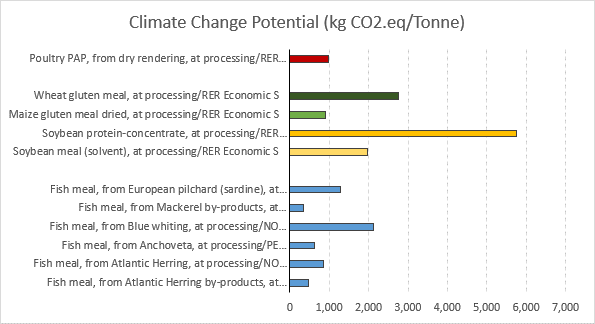
Source: GFLI v2.0 EF3.1 economic allocation data. Data is Europe (RER) or Norway/Peru region based