








Annual Report - 2025
Overview
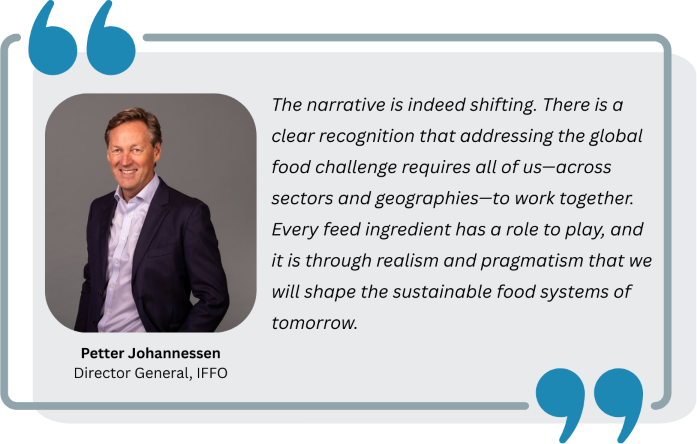
 “The narrative around feed has evolved, with increasing recognition that sustainability must be grounded in robust, science‑based measures such as life‑cycle assessment—not in simplistic comparisons between marine and plant ingredients. As essential providers of irreplaceable nutritional benefits, the marine ingredients hold a strong and enduring position within global food systems. Aquaculture grows only when the feed ingredient sector is diverse, resilient and responsible—making the most of every resource.
In this annual report, we show how IFFO continues to lead these discussions—by sharing best practices from our members, strengthening the evidence base, and supporting academic research that advances our industry. IFFO’s work continues to thrive thanks to the dedication of our team and the active engagement of our Board and global membership.”
Petter Martin Johannessen, IFFO Director General
Contents:
| 1. Supporting our members | 4. Leading projects |
| 2. Events & Webinars | 5. Finance |
| 3. Outreach & Press | 6. Governance |
Supporting our members
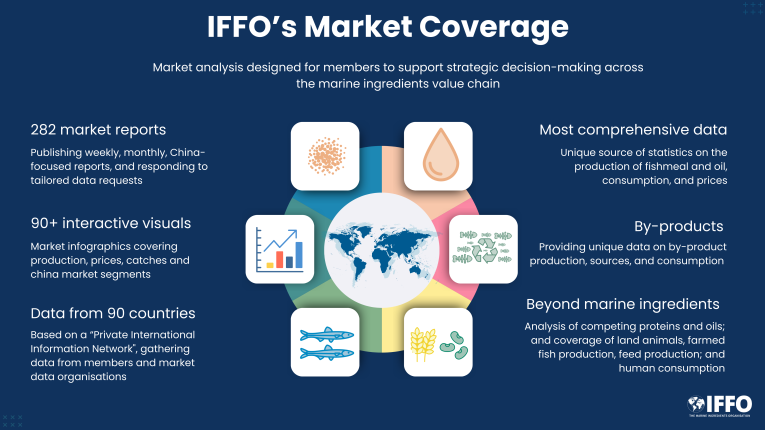
IFFO continues to provide a unique range of services and benefits for marine ingredient producers and their related businesses. With 262 members in total, spanning 40 countries, IFFO membership is growing with 15 new members, including 2 new countries (Malta and Solomon Islands) joining in 2025. This success is echoed by the latest members survey, with 96% of members rating IFFO’s services as either excellent or good. The IFFO team visited members in China, Norway, Denmark, Greece, Singapore, Indonesia, and Malaysia.
Beyond events and communications initiatives, IFFO supports members through a wide range of projects and services, some of which are highlighted in the following:
Click on the icons below to explore more:

Market Coverage and Reports

China

Member Committees
IFFO members can engage directly on projects and join informal discussions through committees: the Communications Network group and the technical and regulatory network (TaRN).

Mineral oil hydrocarbons (MOH)
In 2025, we continued work on mineral oil hydrocarbons (MOH) with the analytical laboratory sector to improve reliability of the analysis methods.

International Maritime Organisation (IMO) bulk shipping (IMSBC) maritime dangerous goods (IMDG) codes
IFFO completed the work on the International Maritime Organisation (IMO) bulk shipping (IMSBC) maritime dangerous goods codes. The changes are voluntary from 1st January 2026 and mandatory from 1st January 2027. This means that the types of antioxidants and minimum residual levels are now the same on both codes, and we now have the new option of a non-dangerous goods code which is open for use of any type of antioxidant at any level so long as evidence is provided demonstrating it has no self-heating potential.

Microplastic Origins and Uptake
IFFO’s multi-partner project investigating microplastics in fishmeal and oil progressed with samples collected, animal trials and analyses was completed in 2025 and awaits peer review in 2026. Fish trials completed in 2022 both showed negligible to no uptake by the fed animals or impacts on their health.
SDG Hub
IFFO’s SDG hub continues to grow with an impressive range of examples of how companies are both mitigating and adapting to climate change. It shows a wide range of action taken from across the industry and provides an important platform to share best practice. Visit the SDG hub
Stakeholder Engagement: Events & Webinars
In-person events:
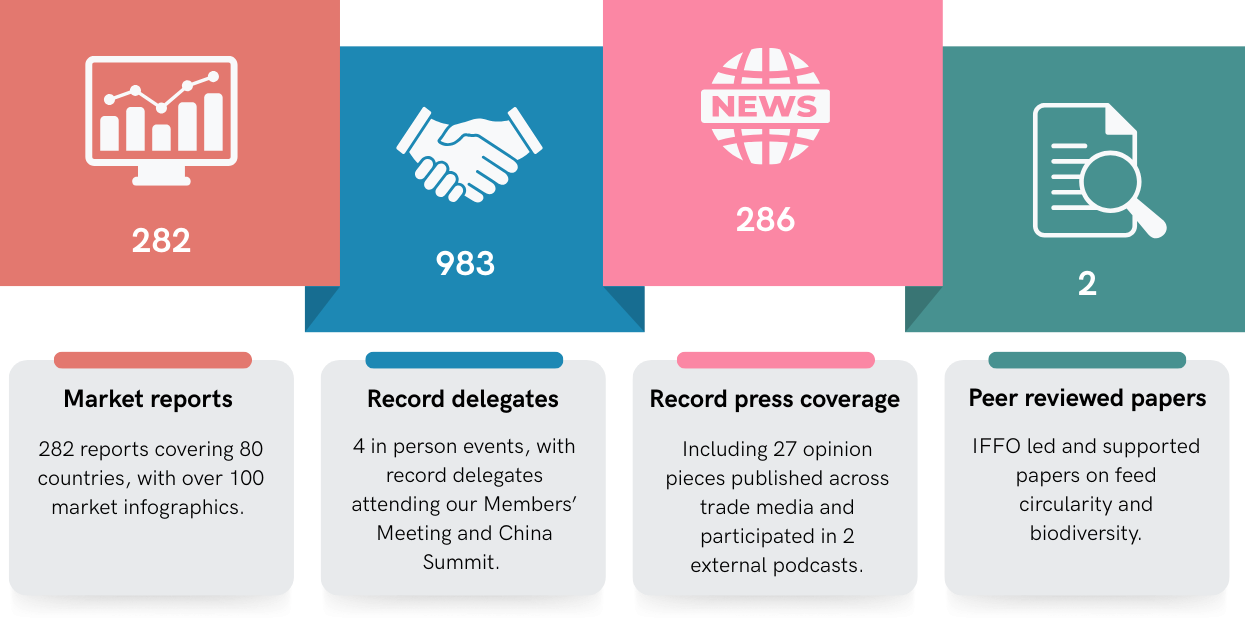
IFFO organised 2 webinars and 4 in-person events in 2025, most notably the record-breaking Members' Meeting held in Madrid, the Annual Conference in Tokyo, the China Summit held in in Foshan city and the Precision Nutrition Workshop in Madrid. With a record 267 members attending the Madrid Members' Meeting and a record 518 delegates attending our Tokyo Annual Conference from 46 countries, these events continue to be the leading gathering for the industry.
The Members' Meeting in Madrid had record attendance and included 21 speakers who explored market trends and market drivers as well as the use of marine ingredients in animal farming and their role in human health. The event also included a MarinTrust side event and a Precision Nutrition Workshop.
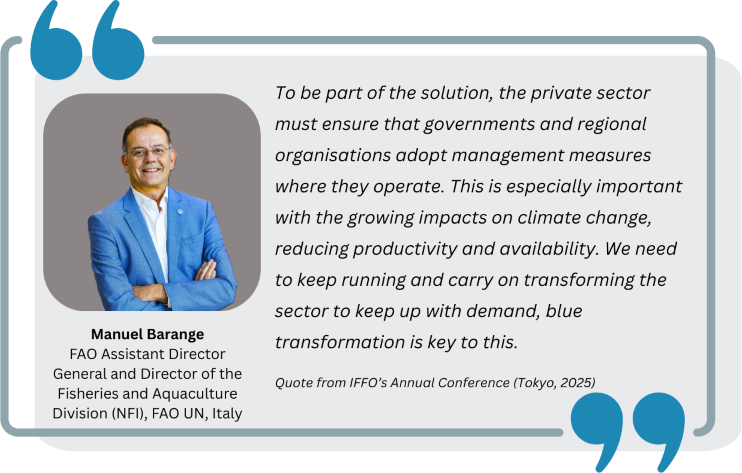
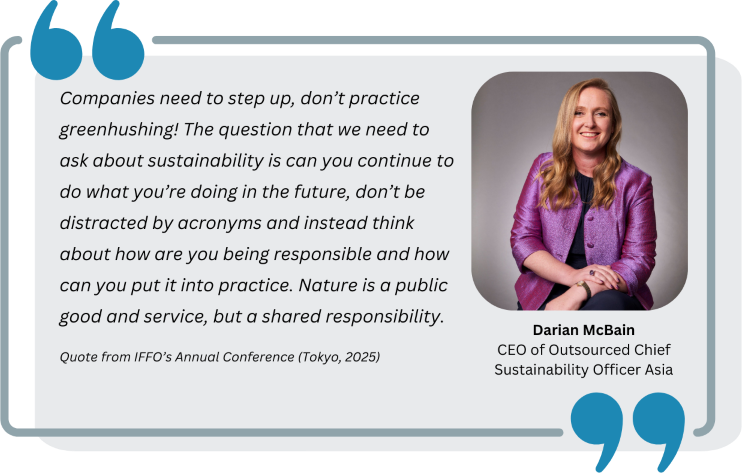
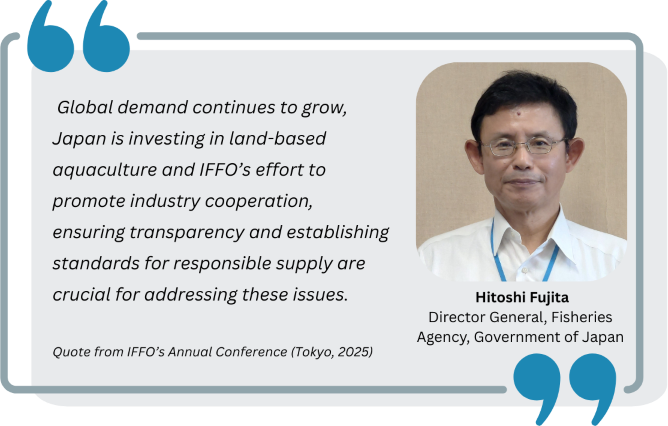
The Tokyo Annual Conference featured 23 speakers Tokyo, with a range of presentations and panel discussions exploring market trends, technical innovation and sustainability updates. Against a backdrop of geopolitical tensions, climate uncertainty, and shifting trade dynamics, industry leaders and scientists came together to reaffirm their commitment to evidence-based decision-making. A central theme of the conference was the critical role of industry in supporting effective fisheries management measures. The conference also addressed the growing need for realism in how aquafeed ingredients are assessed. Side events were held on the Japanese Marine Industry and Sustainability in Japan, and on the reality of by-products with MarinTrust.
The China Summit, was held in Foshan city and was attended by a record number of delegates with 148 from 18 countries. The summit included a global update on marine ingredient markets, with a special focus on Asia. Market updates were also provided on Peru, Chile, Thailand, and the USA before an update from GOED on global omega-3 supply and ending with a focus on fishmeal and fish oil demand in China.
InFocus
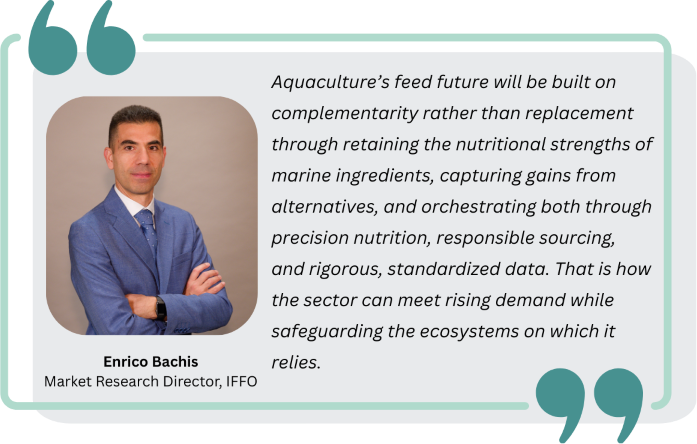
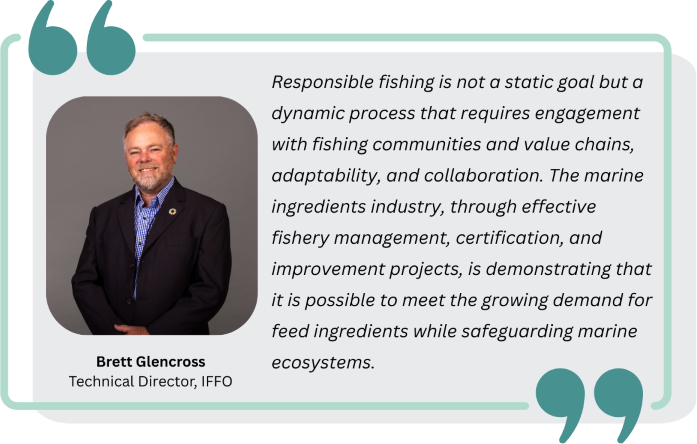
As part of our InFocus technical workshop series, a meeting gathered leading experts from across the feed industry in Madrid to discuss precision nutrition in aquafeed, with a scientific paper published from these discussions. Exploring the fast-developing area of precision nutrition in aquafeed, discussion focused on the important role of palatability, formulation to net energy, omega-3 and amino acid demands, and the latest digital tools to design and assess feed formulations. The workshop featured seven technical experts: Brett Glencross, Technical Director at IFFO, Johan Schrama from Wageningen University & Research, Sofia Morais, from Lucta, Dominique Bureau, from Wittaya Aqua International, Christian DeSantis, from Cargill Aqua Nutrition, Ian Carr, from Veramaris and Kyla Zatti, from BioMar Group.
The InFocus webinars continued, covering Life Cycle Assessment with Global Feed Lifecycle Assessment Institute (GFLI), with Delanie Kellon (GFLI Executive Director) explaing GFLI’s role, providing a globally accessible, evolving animal feed ingredient Life Cycle Assessment (LCA) database and supporting compliant, credible, and transparent environmental assessment of animal feed ingredients. IFFO's Brett Glencross provided an overview of IFFO’s work on data collection, highlighting the need to move toward a more transparent assessment process, with the use of LCA providing a equitable comparrison of the sustainability of each feed ingredient. The second webinar explored IFFO’s market research coverage with IFFO's Market Research team, sharing the latest insights on global marine ingredients production, trade, and usage. The session also explored how IFFO supports its members with high-value intelligence including weekly, monthly, China-focused reports, interactive infographics, presentations, and tailored data requests.
Representing the industry
Every year, IFFO represents the industry at events across the world, contributing the wider industry discussions and highlighting the important role of marine ingredients.
Click on the icon below to view the events that the IFFO team presented at in 2025

Events IFFO presented at:
| Mauritania Fishery Improvement Project Annual Meeting |
| Alltech Lunch n’ Learn |
| Wageningen Fish Nutrition Workshop |
| The North Atlantic Seafood Forum (NASF) |
| The DSM-Firmenich Aqua Days Event |
| Marine ingredients, certification, and assurance for a responsible aquaculture, Athens |
| AquaNor 2025 |
| IFFO Members' Meeting Madrid |
| The Responsible Seafood Summit |
| IFFO InFocus Workshop - Precision nutrition in aquafeed |
| The Global Shrimp Forum |
| IFFO China Summit Foshan City |
| AquaFarm |
| IFFO InFocus Webinar - Life Cycle Assessment & GFLI |
| FAO Fish Price Index workshop |
| IFFO Annual Conference Tokyo |
| The OECD-GFLI Workshop |
| The Pelagic Forum |
| The 8th Grain, Oil and Feed Industry Conference 2025 |
| IFFO InFocus Webinar - Market Statistics |
| Seafood Expo Asia |
Stakeholder Engagement: Outreach
IFFO grows out of a fishmeal and fish oil industry need for collaboration, information and shared problem solving. Beyond IFFO’s efforts to facilitate cooperation and address shared commercial problems within the membership, IFFO constantly liaises with academia, regulatory bodies, governments, international organisations and industry press. IFFO provides a reference point for marine ingredients with the IFFO website, which features videos of experts, while also engaging stakeholders directly on social media via LinkedIn and WeChat, Bilibili, the Red, Weibo in China.
Press engagement
IFFO responded proactively to all media and NGO requests, while driving discussions on marine ingredients through 17 press releases , 27 opinion articles, along with blog articles, and participated in 2 external podcasts, resulting in 286 pieces of positive global press coverage. IFFO actively engages on social media with over 6,400 followers (up by 1,200 in the last year) on LinkedIn. In China, IFFO is active on 4 social media platforms, with 404 new followers and 22,284 hits gained in 2025 on WeChat. IFFO’s China vodcast series released on these platforms as well as on IFFO website have received 13,612 views by end of 2025.

The Global Roundtable on Marine Ingredients
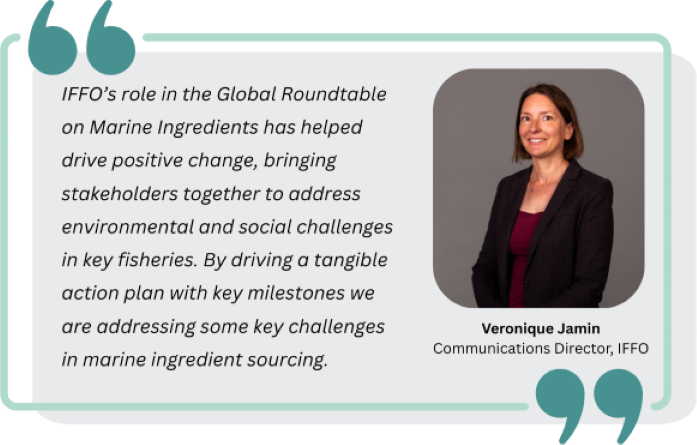
IFFO Participated in and held the role as Secretariat for Global Roundtable on Marine Ingredients, with active workstreams on West Africa and South and South East Asia. Meetings were held at the EU Commission and FAO to discuss regional management of shared fish stocks in West Africa. A workshop was held in Mauritania (July 2025) and IFFO participated in the Mauritania Fishery Improvement Project's Annual meeting in Nouakchott in January 2025. Overall, this workstream has contributed to improvements in the area, from supporting the country’s small pelagic management plan which led to a ban on certain fish species for marine ingredient production, upgrades to vessels and factories to prioritize direct human consumption of small pelagic fish, and a shift in exports from fishmeal to fresh and frozen products. The Global Roundtable has also been supportive of efforts made in Southeast Asia, where countries like Thailand, and Vietnam are making progress with certified facilities and fishery improvement projects. In India, certification uptake remains low while two fishery improvement projects are in place. To address this, the Global Roundtable will soon be commissioning a socio-economic study to identify barriers and opportunities for better recognition of marine ingredients on global markets, ensuring those products meet the requirements of global standards.
Find out more in the Roundtable’s Annual Report.

Science-based communications for a general audience

Information resource for marine ingredients
- The story of marine ingredients from start to end - exploring the sources, production and uses of marine ingredients with academic and market data from across the industry.
- Market statistics - provides a summary of marine ingredient production and demand
- Studies of interest - a library of academic papers on marine ingredients and related industries
- Key Facts - Easily digestible ingfographics on marine ingredients, from their sources, uses and sustainability metrics.

Work with the Global Feed LCA Institute (GFLI)

The role of marine ingredients in a circular food system
Peer reviewed article published Reviews in Fisheries Science & Aquaculture: Toward Applying a Circularity Framework Against the Use of Aquaculture Feed Ingredients
The study, led by Dr Brett Glencross, IFFO’s Technical Director, along a team of seven renowned scientists and industry representatives, highlights the need for a more comprehensive and holistic approach to sustainable feed and food production.
Dr Glencross commented: “One of the key drivers of circularity is the need to improve sustainability of feed ingredient use. This review demonstrates that a more comprehensive approach to sustainable feed and food production is possible, particularly through life cycle assessment (LCA) methodologies. By applying a common, agreed set of rules, we can ensure that environmental burdens are not simply transferred from one product to another.”
LCA data shows that marine ingredients have a lower carbon footprint than many other ingredients, and reducing their inclusion increases the carbon footprint of aquafeeds.
Published date: September 2025

Journal: Reviews in Fisheries Science and Aquaculture
Biodiversity Consequences of Replacing Animal Protein From Capture Fisheries With Animal Protein From Agriculture (stemming from an IFFO supported workshop). Led by Duncan Leadbitter (Australian National Centre for Ocean Resources and Security, University of Wollongong).
“This peer-reviewed article underscores the essential role of responsibly managed fisheries in sustainable food systems and biodiversity protection. Despite their impacts, agricultural systems remain vital for feeding a growing population. However, more tools are needed to enable objective, localized comparisons between the biodiversity impacts of land-based animal protein production and marine fishing. With this in mind, IFFO has started a pilot project to transition current discussions to a biodiversity framework outlining indicators to measure impacts and guide decision-making,” said Dr Brett Glencross, IFFO’s Technical Director.
Published date: December 2025

FAO Technical Recognition
IFFO received an Honour by the FAO as part of its first-ever Technical Recognition Ceremony. This honour celebrates excellence in technical contributions to global food systems. IFFO was selected from over 1,000 applicants and stands among only 46 organisations recognised in the Sustainable Aquatic Food Systems category.

IFFO 2025 Accounts
| IFFO (2012) LIMITED | ||||
|
(A company limited by guarantee) REGISTERED NUMBER: 08206502 |
||||
| BALANCE SHEET - AS AT 31 DECEMBER 2025 | ||||
| 2025 | 2024 | |||
| $ | $ | |||
| Fixed assets | ||||
| Tangible assets | 343,146 | 334,903 | ||
| Investments | 1 | 1 | ||
| 343,147 | 334,904 | |||
| Current assets | ||||
| Debtors: amounts falling due within one year | 189,627 | 336,087 | ||
| Cash at bank and in hand | 1,873,707 | 1,749,636 | ||
| 2,063,334 | 2,085,723 | |||
| Creditors: amounts falling due within one year |
(288,780) | (343,739) | ||
| Net current assets | 1,774,554 | 1,741,984 | ||
| Total assets less current liabilities | 2,117,701 | 2,076,888 | ||
| Net assets | 2,117,701 | 2,076,888 | ||
| Capital and reserves | ||||
| Other reserves | 148,132 | 4,053 | ||
| Profit and loss account | 1,969,569 | 2,072,835 | ||
| 2,117,701 | 2,076,888 | |||
| STATEMENT OF CHANGES IN EQUITY - FOR THE YEAR ENDED 31 DECEMBER 2025 | |||
| Foreign currency reserves |
Profit and loss account |
Total equity | |
| $ | $ | $ | |
| At 1 January 2025 | 4,053 | 2,072,835 | 2,076,888 |
| Comprehensive income for the year | |||
| Loss for the year | - | (103,266) | (103,266) |
| Revaluation movement | 144,079 | - | 144,079 |
| Other comprehensive income for the year | 144,079 | - | 144,079 |
| Total comprehensive income for the year | 144,079 | (103,266) | 40,813 |
| Total transactions with owners | - | - | - |
| At 31 December 2025 | 148,132 | 1,969,569 | 2,117,701 |
| STATEMENT OF CHANGES IN EQUITY - FOR THE YEAR ENDED 31 DECEMBER 2024 | |||
| Foreign currency reserves |
Profit and loss account |
Total equity | |
| $ | $ | $ | |
| At 1 January 2024 | (8,365) | 2,315,566 | 2,307,201 |
| Comprehensive income for the year | |||
| Loss for the year | - | (194,757) | (194,757) |
| Currency translation differences | - | (47,974) | (47,974) |
| Revaluation movement | 12,418 | - | 12,418 |
| Other comprehensive income for the year | 12,418 | (47,974) | (35,556) |
| Total comprehensive income for the year | 12,418 | (242,731) | (230,313) |
| Total transactions with owners | - | - | - |
| At 31 December 2024 | 4,053 | 2,072,835 | 2,076,888 |
Governance
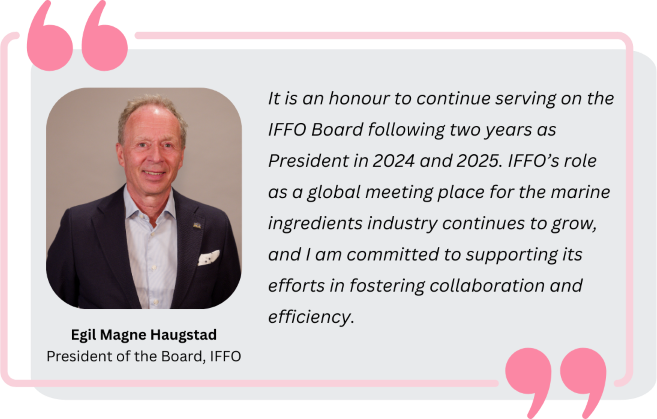
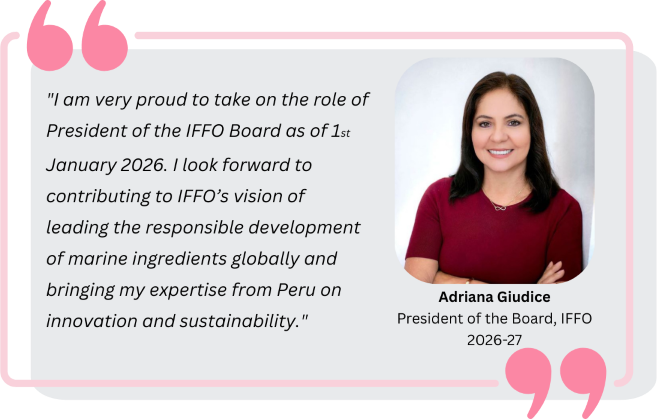
The Board of Directors of IFFO is made up of Directors from Producer members nominated by either individual countries or regions. Each director serves a 2-year term and is then eligible for re-election. Meetings are held at least twice a year, along with more regular meetings for smaller Liaison groups to focus on specific areas.

Board of Directors for 2024-2025 term
| Latin America: Adriana Giudice (Vice President), José Miguel Tirado, Gonzalo De Romaña, Fernando Ribaudo, Walter Martinez, Felipe Zaldivar, Eduardo Goycoolea and Armando Coppel |
| Europe: Johannes Palsson, Egil Magne Haugstad and Johann Peter Andersen |
| USA & Canada: Dan James |
| Rest of the World: Andre du Preez and Mohammed Shawkath Showry |
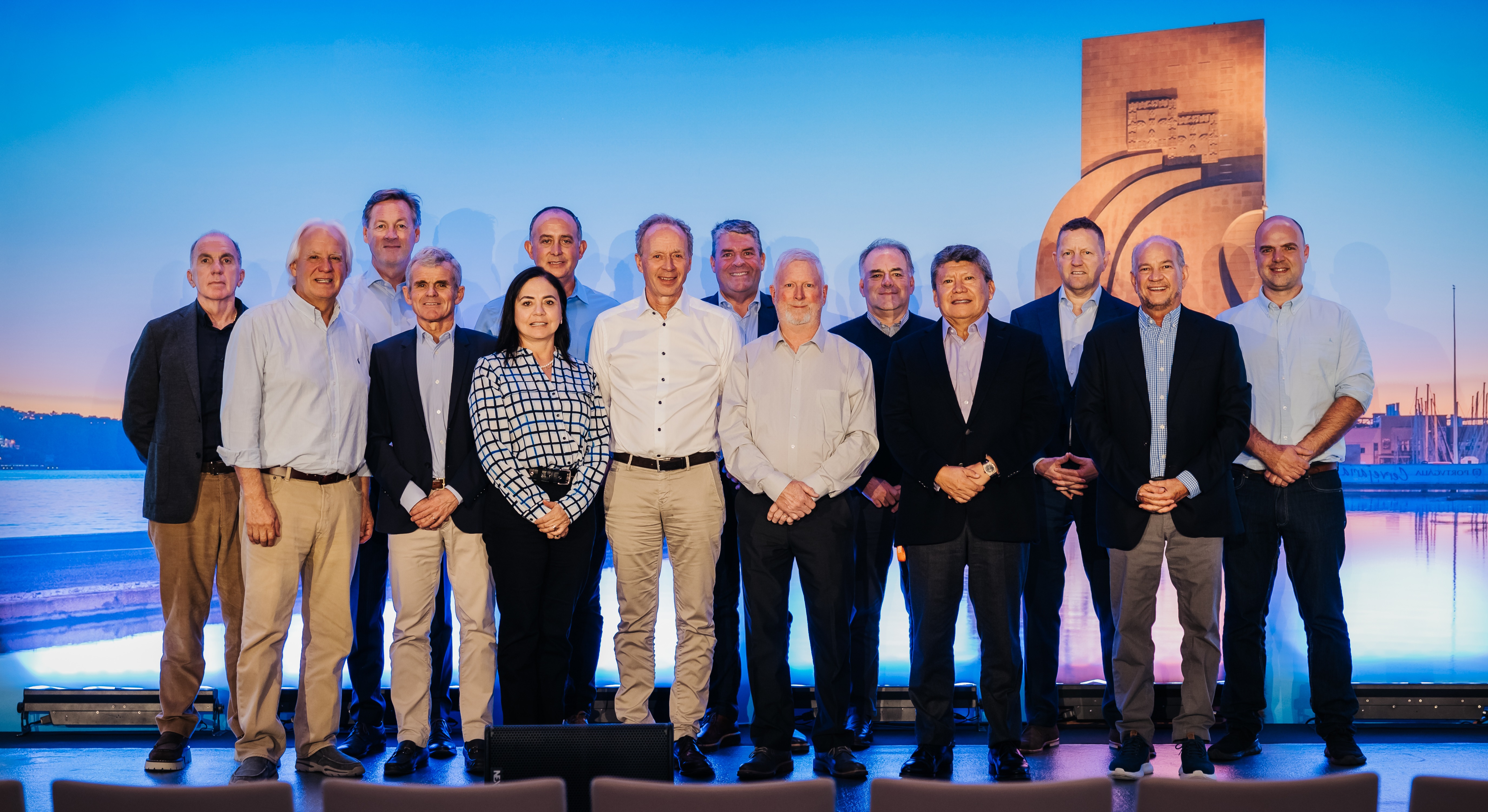
Back row (from left to right): Fernando Ribaudo, Petter Martin Johannessen, Gonzalo De Romaña, Johannes Palsson, José Miguel Tirado, Andre du Preez
Front row (from left to right): Eduardo Goycoolea, Felipe Zaldivar, Adriana Giudice, Egil Magne Haugstad, Dan James, Walter Martinez, Armando Coppel.