








This article was published in the November 2025 edition of International Aquafeed and authored by Dr Brett Glencross
During the last thirty years the use of fishery resources for non-food purposes (e.g. fishmeal) has declined from ~30 million tonnes to now less than 20 million tonnes per annum (which now represents less than 10% of the combined production of aquaculture and fisheries). Despite that decline in whole fish resource use, fishmeal production has maintained its volume at 5+ million tonnes per annum. How? Largely through increased reliance on by-products from both fisheries AND aquaculture.
What do we mean by “by-products”? These are those secondary product streams that we produce when we process fish for direct human consumption. Most fish have a meat yield somewhere in the range from 40% to 60%. Notably, of which is much higher than that from terrestrial animals which are as low as 33% meat yield. Meat, however, is not the only thing of value we produce from animals. While we often think of animal production as a source of animal protein, products such as leather, fibre, and feed resources are other key outputs. It is all part of a long-standing circular-protein approach to zero-waste.
When we explore that by-product production story in the marine ingredient sector, we see an interesting dichotomy in where fishmeal and fish oil are derived from (Figure 1). By-product fishmeal is predominantly produced from wild-capture species. Fish like Alaskan pollock, Atlantic mackerel, Haddock and so on. Wild caught tuna by-products are also a major source of fishmeal globally. Another source is some of the larger intensive aquaculture industries of salmon, pangasius and tilapia farming, which combined contribute to the production of several hundred thousand tonnes of fishmeal each year. Notably, the growth of by-product sourced fishmeals over the past five years has grown by more than 500 thousand tonnes. A growth rate which eclipses the combined production of insect, algal and single-cell products combined. The total production of fishmeals from by-products now is about two million tonnes a year, making up about 40% of global fishmeal production. Most by-product fishmeal is used in aquaculture feeds, with salmon meal being a commonly found ingredient in southeast Asia. Alaskan pollock meal is commonly used fishmeal in China. While by-product meals sometimes lack some of the physico-chemical properties of whole-fish fishmeals, they still maintain their strong palatability properties helping improve intakes of compounds feeds which these days are made predominantly from plant proteins.
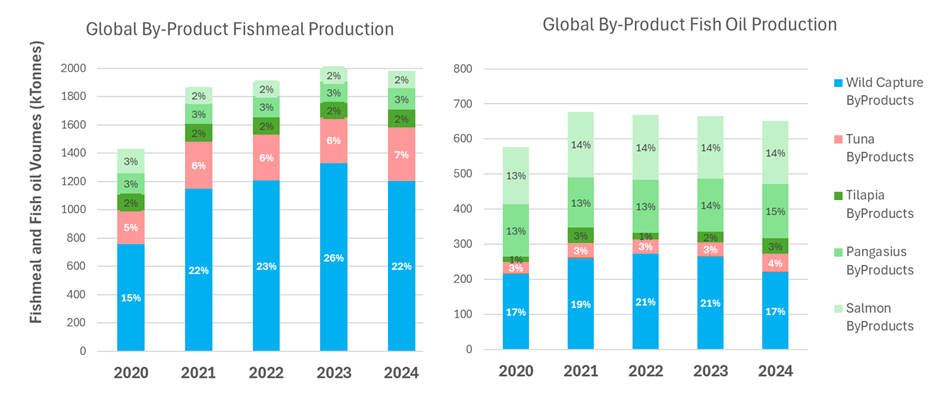
Figure 1. Global marine ingredient production from by-product streams since 2020. Percent values overlaid are the percent of total fishmeal or fish oil production in each year.
Fish oils tell a slightly more impactful story. Global production is around 650 thousand tonnes per annum in total production of about 1.2 million tonnes. In recent years global fish oil production from by-products has consistently exceeded 50% of total global production. For by-product fish oils, aquaculture has become a major supplier of the resource base for production. Particularly those species with high fat loads like pangasius and salmon. Much of that pangasius oil being used as a cooking oil in southeast Asia, and the salmon oil forming the basis of feeds for other many other aquaculture species like marine fish and shrimp across the world. Wild sourced by-products are also a major source with species like Atlantic mackerel, Atlantic herring and Chilean jack mackerel being significant sources of by-product fish oils. Much of this oil forming the basis of aquacultured salmon feeds in both the North Atlantic and Chilean salmon production regions.
Combined we can see how this evolving production of fishmeals and oils from by-products, and the reuse of those products across global supply chains, is transitioning the marine ingredient sector and increasingly becoming a benchmark of zero-waste circular feed systems. With the continued growth of aquaculture, the future supply of fishmeal and fish oil is on a positive trajectory.