








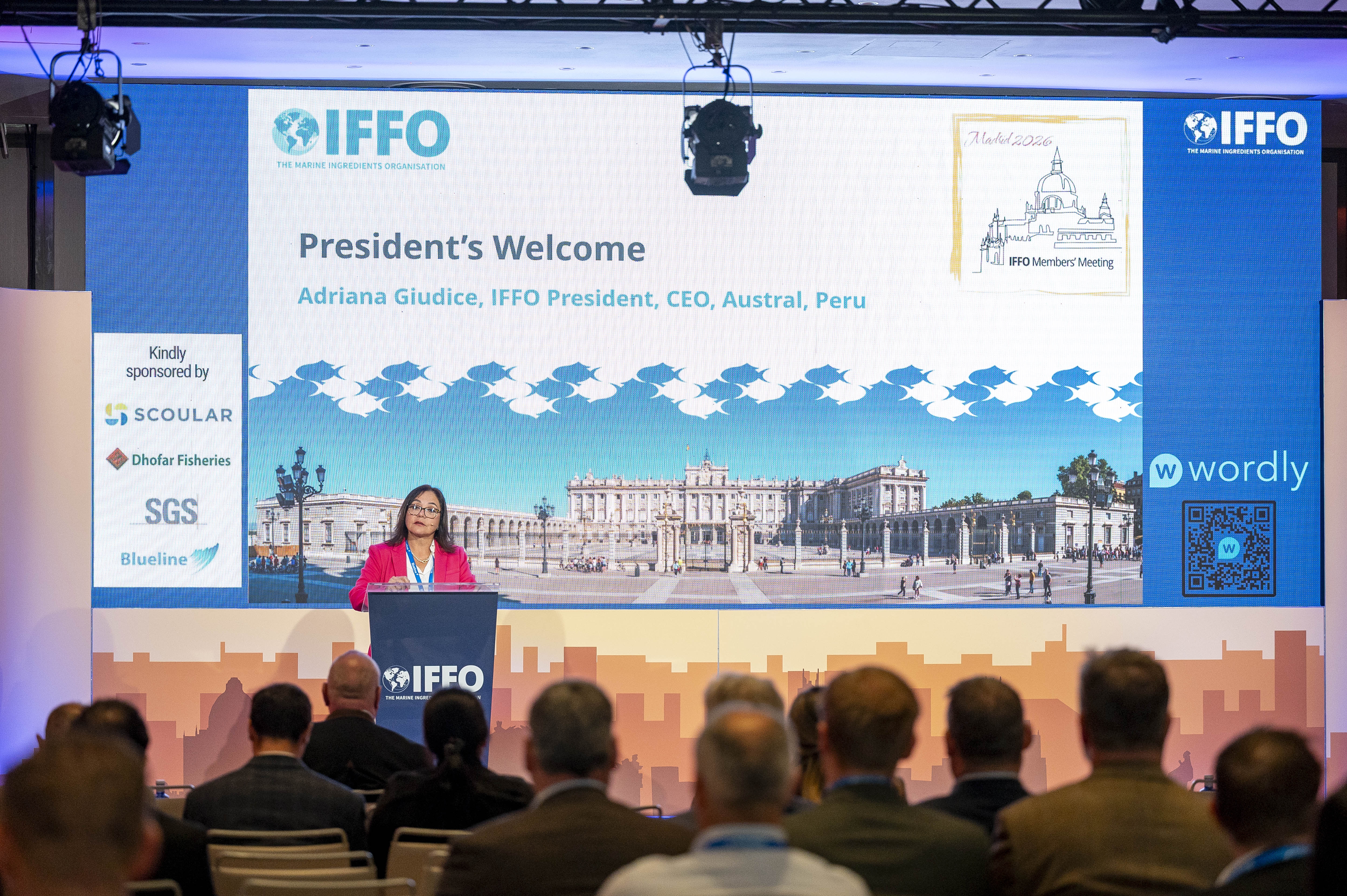
IFFO’s Members’ Meeting was held in Madrid for the second consecutive year from 27th-29th April 2026 and welcomed a record 275 delegates from 35 countries. The meeting brought together industry leaders from across the world to discuss the latest developments related to marine ingredients, market trends, sustainability challenges, innovation, and global supply dynamics. Opened by IFFO’s President Adriana Giudice, she declared that “marine ingredients play a unique and often unrecognised role in the global food system, and this event will provide an update on how these vital ingredients are being used around the world and future trends.”
Taking a proactive approach
 Looking at IFFO’s work, Director General Petter Martin Johannessen discussed IFFO’s scientific based and proactive approach, with a raft of publicly available market and scientific reports, along with clear infographics on key messages, ensuring that this industry is accurately presented. He added that “scientific consensus is gradually catching up to the nuances we have long emphasised. The diversification of feed ingredients over the past two decades has broadened supply but often introduced higher emissions. The aquafeed sector’s current challenge lies in unifying around common metrics and this is also a huge opportunity for our sector”.
Nature is in the driving seat for fish stocks
Speaking remotely, fisheries expert Prof. Ray Hilborn (University of Washington), provided an update on fisheries stock assessments and research trends. Providing an overview of his team’s fishery stock database and recent papers, Hilborn noted that while on the whole, fish stocks are stable, data gaps remain in Asia due to the lack of fishery assessments. For small pelagic fisheries, Hilborn added that stocks are on average very stable and above the average of maximum sustainable yield (MSY).
The growing threat of climate change does however remain, changing both fish distribution and productivity, resulting in winners and losers in terms of species and stocks. He commented on the anti fishing movement, noting that while this is often driven by genuine conservation concerns, the increasing funding needs of environmental NGOs is often driving negative media. In response, Hilborn summarised a recent biodiversity paper, which showed that ‘in order to replace all animal protein from marine fisheries, an addition 5 million km2 of land could be required. While replacing all fish in aquaculture diets would result in the need for over 47,000 km2 of new land converted to agricultural production. Finally, eliminating only whole-fish from fishmeal production would require over 20,000 km2 of new land.”
On rebuilding fish stocks, Hilborn explained that this can be done by setting and following sustainable harvest limits combined with balancing fishing capacity with resource availability, and this can be one part of a decarbonization strategy. When analysing fish stock assessments by International Council for Exploration of the Sea's (ICES), Hilborn explained that with “small pelagic fishes, generally recruitment drives biomass, not biomass driving recruitment and thus we can’t control the trends in the stocks much, nature is mostly in the drivers seat”.
Adapting and knowing the strengths of ingredients
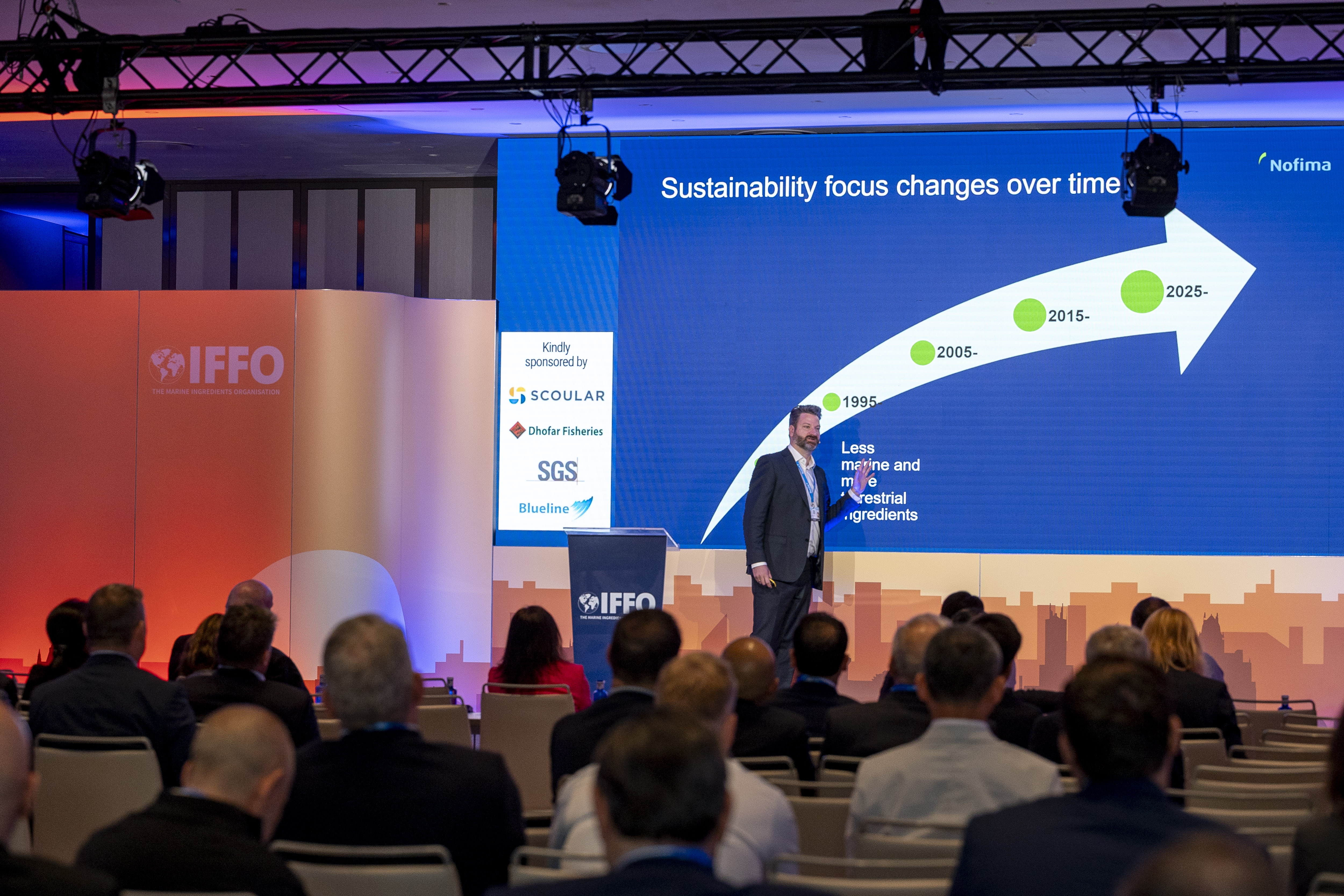 Looking at recent research and innovation trends in feed, Nofima’s Research Director, Dr. Erik-Jan Lock, presented the changing landscape of feed ingredients in aquaculture, analysing the most notable shift with the increasing reliance on terrestrial ingredients, while other alternatives, such as insect meals, single‑cell proteins, and even seaweed, have gained visibility in public discourse as promising sustainable options.
“The introduction of carbon footprint and life cycle analysis reporting has transformed how aquafeed ingredients are evaluated. Since 2019, salmon aquafeed carbon footprints have been reduced by around 40%, primarily through improved sourcing strategies. Insects meals have quite a high footprint and several companies have now gone bankrupt. As opportunities for further reductions within existing ingredient categories diminish, the focus is moving toward new alternatives like low trophic marine ingredients like macroalgae, blue mussels, tunicates (which are very slow at scaling) or circular ingredients. As for animal by-products, we see high variability in their digestibility.”
Lock added that the development of more tailored nutrition, such as precision nutrition, means that formulators know the overall nutrient requirement of a species, under specific conditions, and at specific life-stages. Interest is growing in immunostimulants, while precision fermentation and functional ingredients are also receiving a lot of traction. Climate change is driving more vulnerabilities in feed ingredients, and Lock noted that contingency planning is key and although it should be, it is not being driven by governments.
He referred to Halley et al.’s No Free Lunch research paper, published in 2025, highlighting that «aquaculture, and aquafeed in particular, should be judged by how efficiently it converts resources into nutritious food, not by unrealistic expectations of zero impact. Progress matters, context matters, and there is no free lunch in any food system.
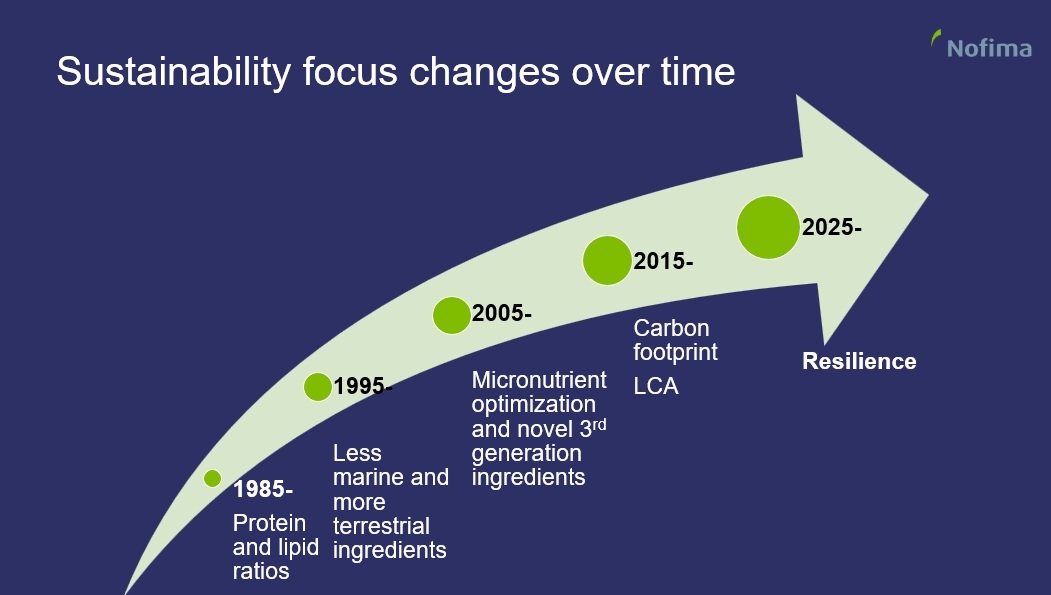
He concluded by stating that “evolving sustainability standards and rising market expectations for transparency have become the major forces driving innovation in novel feed ingredients. Terrestrial ingredients are now more on the backfoot and the time could be right to develop a more diversified product portfolios, with speciality products that can really help with diet formulations. Fishmeal is much more than just a good protein source and fish oil is more than a just a good omega-3 fatty acid source. They have a key role to play in the precision nutrition approach”.
Closing the loop of the circular economy
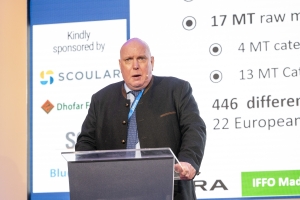 Moving to recent developments in animal by-products, Dr Martin Alm, Technical Director at The European Fat Processors and Renderers Association (EFPRA), summarised that like marine ingredients, proteins and fats from land animals are valuable and sustainable resources in animal feeding. In Europe, Alm summarised that feed grade proteins and fats are produced from by-products of healthy slaughtered animals and by standardised and approved processing methods. Safe sourcing and processing as well as full traceability and transparency are required at all stages to guarantee that the feed ingredients are of high safety. In aquaculture, land animal proteins are used in aquafeed worldwide as a natural source of essential amino acids. The use of processed animal proteins from non-ruminant animals in aquafeed has been allowed in the EU for many years, and since 2021 they are also allowed in the feeding of pig and poultry. The biggest market is pet food. Half of the animal by-products used in aquafeed comes from poultry, followed by feather meal.
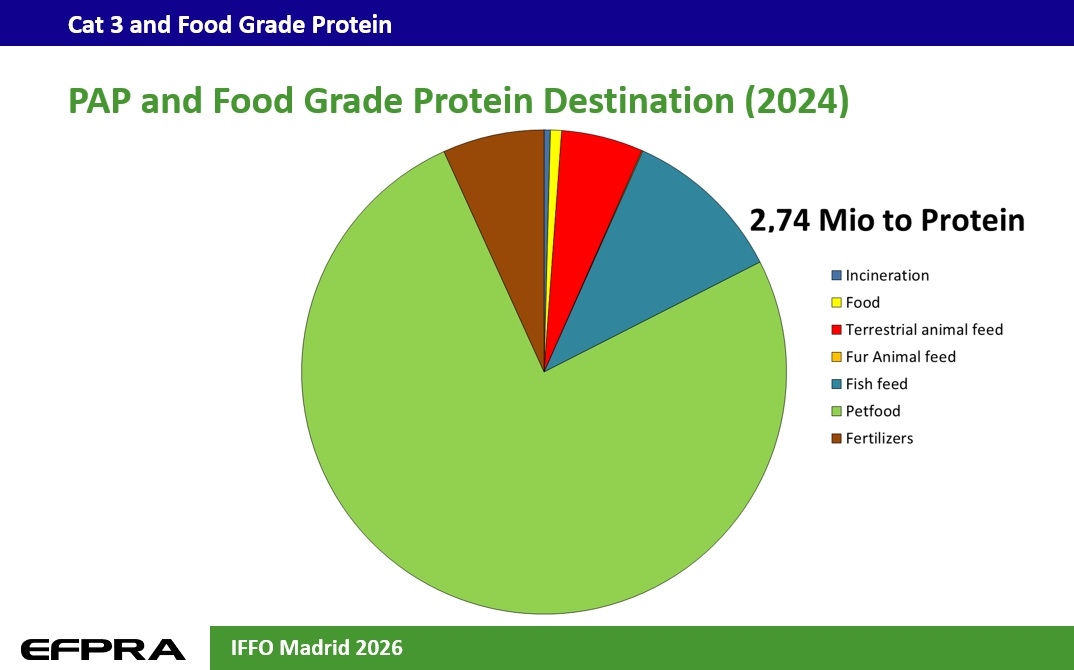
Alm concluded that “as the world’s population grows, food and food production grows even quicker with fewer resources and less agricultural land availability. Conservation of resources is key, while fighting food waste and increasing the use of by-products in feed has become a necessity!”
The event continues on the 29th April , focusing on demand for marine ingredients.