








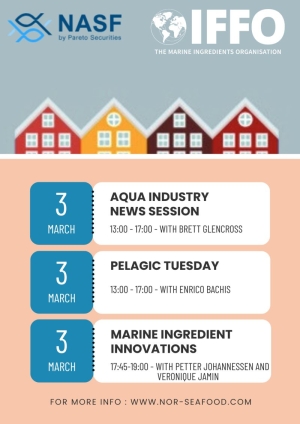
 The 2026 North Atlantic Seafood Forum took place in a context defined by accelerating geopolitical pressures. Across panels and discussions, several overarching themes emerged, many of which underscore the strategic role of aquafeeds. IFFO was represented in several sessions, from the Aqua Feed Industry News session to Pelagic Tuesday and Unlocking innovations in marine ingredients.
From ingredient replacement to nutrient security
One of the most consistent messages throughout NASF was its focus on long‑term nutrient security.
Demand for omega‑3s continues to rise, and limiting fishmeal/fish oil inclusion too rigidly risks nutritional gaps in aquafeeds and the human food chain. Diversification is important and all ingredients have a role to play.
Aquafeed science is evolving rapidly, with consequences for how marine ingredients are used:
- There is growing emphasis on precision nutrition: optimising ingredient functionality rather than simply managing inclusion rates.
- Welfare considerations (inflammation control, skin condition, immune function, heart health) are more tightly integrated into feed design.
- Discussions around vitamin D, phosphorus utilisation, and bioactive compounds highlighted a trend: the fish’s physiological needs are being understood in greater detail, and feed must respond accordingly.
The sustainability agenda is becoming more complex: speakers repeatedly emphasised that sustainability expectations have expanded and evolved: early sustainability discussions centered on climate, green bonds, and large finance projects. Today, social responsibility, from labour conditions to community benefits and fair value chain, is equally prominent. Certification systems must remain dynamic, not static, to reflect new knowledge and maintain trust with consumers and markets. Stakeholders called for more transparency across value chains, including fisheries management, feed ingredients, and aquaculture practices.
For IFFO, this validates the sector’s efforts to advance both technical innovation and social responsibility, including initiatives such as the Global Roundtable on Marine Ingredients.
A 2026 study published in the Journal of Cleaner Production got traction at NASF. It highlights that reductions in marine ingredient inclusion have come with significant environmental costs. The authors note that despite their potential, many novel feed ingredients currently underperform environmentally due to their reliance on fossil fuel based energy and the absence of large scale industrial production. Between 2000 and 2020, while European aquaculture production nearly doubled (from 1.15 to 2.17 million tonnes), the total Wild Fish Use (WFU) decreased by 13%. Yet during the same period, Global Warming Potential rose by 314%, land use by 594%, water consumption by 236%, marine eutrophication by 630%, and freshwater eutrophication by 468%.
Resilience in a volatile world: supply chains under new geopolitical pressures
A defining theme was the extent to which geopolitics now shapes seafood production, particularly feed ingredients: the blue whiting fishery remains a critical but unresolved point of uncertainty.
Multiple speakers highlighted that the main constraints to seafood sector growth are regulatory and political, rather than demand‑related. Markets for seafood remain strong, with increasing demand in China in a context of urbanisation.
Circularity and governance
Across sessions, there was broad recognition of the progress made in circularity: fish by-products now account for 34% of fishmeal and 55% of fish oil production.
Strong governance, credible certification, and sound fisheries management are critical for the industry’s future stability. For IFFO, the event reaffirmed the importance of its work in delivering scientific clarity, promoting responsible production, and ensuring trusted supply chains for the global seafood industry.