








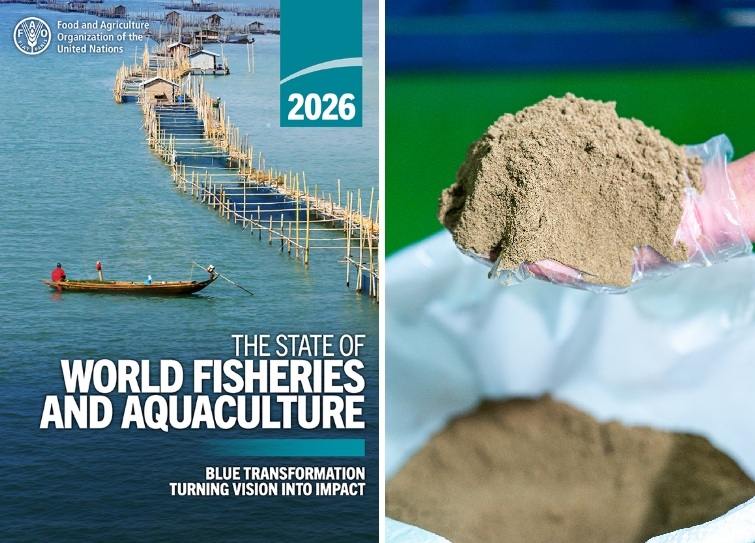
The Food and Agriculture Organisation’s State of world fisheries and aquaculture 2026 report provides important insights that are particularly relevant to the fishmeal and fish oil sector, underscoring its continued importance, resilience and adaptability.
From a marine ingredients industry perspective, the findings reaffirm several long-standing industry messages: that fishmeal and fish oil production has stabilised despite growing aquaculture demand, that resource efficiency is improving through the increased use of by-products, and that these marine ingredients remain indispensable in enabling sustainable aquaculture growth.
A growing sector supported by stable marine ingredient supply
The report highlights that global aquaculture production reached a record 103 million tonnes in 2024, confirming its position as the fastest-growing food production system worldwide. This expansion is expected to continue, with aquaculture accounting for the vast majority of projected growth in aquatic food production through to 2034.
Despite this rapid expansion, a key message for the fishmeal and fish oil sector is that growth in aquaculture has not translated into increased pressure on fisheries. The volume of whole fish used for marine ingredients production has declined over time, and the proportion of capture fisheries dedicated to fishmeal and fish oil production has fallen significantly since the 1990s.
Today, roughly 20% of total capture production is used for fishmeal and fish oil production, compared with approximately 32% at its peak. Moreover, overall production of fishmeal and fish oil has remained remarkably stable since the mid-2000s, averaging around 5 million tonnes and 1 million tonnes respectively.
This stability reflects both improved fisheries management and the sector’s increasing efficiency. Marine ingredients are not driving overfishing; rather, they are part of a well-managed and increasingly efficient value chain.
Improving resource efficiency through by-products
One of the most significant developments highlighted in the report is the growing use of by-products in marine ingredient production: 34% of global fishmeal production and 54% of fish oil production in 2024.
By utilising trimmings and by-products from fish processing, the industry is producing circular, low carbon raw materials, while improving overall efficiency. This shift towards by-product utilisation is set to continue with the growth of the aquaculture sector.

Essential nutrition for aquaculture performance
Another important theme in the report is the changing composition of aquafeeds. Fishmeal and fish oil remain essential components, particularly in critical life stages such as hatchery and broodstock production. Inclusion rates of marine ingredients in aquafeeds have declined over time due to improved feed efficiency and diversification of raw materials, meaning that their strategic use targets where their unique nutritional properties deliver the greatest value.
Fishmeal provides highly digestible protein and essential amino acids, while fish oil remains the primary source of long-chain omega-3 fatty acids such as EPA and DHA. In this sense, fishmeal and fish oil act as nutrient enablers, supporting the production of healthy, high-quality aquatic foods

Strong demand and resilient markets
The State of world fisheries and aquaculture 2026 report also illustrates the resilience of global markets for marine ingredients. Demand remains strong despite fluctuations in production volumes and price volatility. This is driven not only by aquaculture needs but also by growing demand from human nutrition sectors, including dietary supplements.
China remains the largest importer of fishmeal, reflecting the size of its aquaculture industry, while Norway and China are key destinations for fish oil. These trade patterns highlight the global nature of the sector and its integration within international food systems.
This demand reinforces the need for responsible sourcing and transparent supply chains to maintain stakeholder confidence and enable that the growth of the aquaculture sector relies on sustainability and traceability principles.
Future challenges
The report does not shy away from highlighting ongoing challenges. Concerns remain regarding the governance of certain fisheries supplying raw materials, particularly where local food security considerations intersect with export-oriented production. This is where IFFO is focusing its attention alongside members of The Global Roundtable on Marine Ingredients.
The report stresses the importance of strong fisheries management, effective governance frameworks and international cooperation. Initiatives such as certification schemes and the adoption of responsible management practices have already contributed to increasing the share of responsibly sourced fish used for fishmeal production.
Another key challenge is the need to understand the complementarity of all feed ingredients to support future aquaculture growth. While novel ingredients exist, they face economic and scalability barriers. It is also important that they do not produce trade-offs that deteriorate aquafeeds’ environmental footprint and contribute to further developing non-competing resource production.
Reinforcing the role of marine ingredients in blue transformation
The report emphasises the concept of "blue transformation", which seeks to expand aquatic food systems in a sustainable, inclusive and resilient manner. Fishmeal and fish oil are integral to this vision and their role was scrutinised in a dedicated analysis we made when the Blue Transformation roadmap was released.

By enabling efficient aquaculture production, contributing to circular economy practices through by-product utilisation, and supporting the delivery of nutrient-rich foods, marine ingredients are a key component of sustainable food systems.