








The third day of IFFO’s Annual Conference featured presentations and discussions on the global demands and complexities of marine ingredients, progress in Responsible Sourcing and updates on the omega-3 markets.
Marine ingredient gravitate to where the value is
IFFO’s Market Research Director Enrico Bachis set the scene with a review of global demand trends for fishmeal and fish oil based on IFFO’s estimates for 2025. He summarised that “both fishmeal and fish oil are gravitating where the value is, with fishmeal exports soaring by +11% and fish oil by +19% in 2025, led by Peru (+29% and +53%). There was huge growth in exports from emerging origins such as India and Oman, showing how globalised this industry is becoming.”
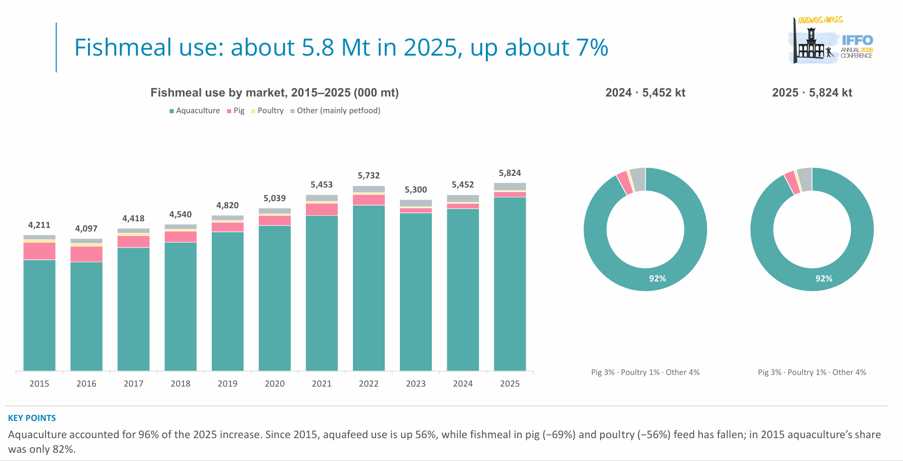
 Bachis showed that in 2025, aquaculture consumed 92% of fishmeal and 72% of fish oil, driving almost all of the growth in 2025. Of that China uses 47% of the aquafeed fishmeal and takes 47% of world fishmeal imports. For fishmeal, he added that aquaculture accounted for 96% of the 2025 increase consumption, and since 2015, aquafeed use is up 56%, while fishmeal in pig (−69%) and poultry (−56%) feed has fallen; in 2015, aquaculture’s share was only 82%. For fish oil consumption, Peru (+53%) and Chile (+47%) supplied 56% of the global increase, lifting their combined share to 27% (21% in 2024). Mexico (+143%) and India (+119%) exports have also grown greatly in the last year. Overall consumption of fish oil has grown by 9% with aquaculture accounting for virtually all of the 2025 increase, with a total use of still 6% below the 2022 peak. In terms of fish oil consumption by fed fish species in 2025, salmonids 60% lead (up by 10%), followed by marine fish (22%) and crustaceans 15%.
Fishmeal consumption by pig and poultry sectors are down by 69% and 56% since 2015, with inclusion levels dropping. In terms of species consumption, salmon salmonids take 60% of aquafeed fish oil, with Europe and the Middle East consuming 53% of it. Trade fishmeal exports were up by +11% and fish oil were up by +19% in 2025, led by Peru (+29% and +53%). Bachis added that beyond feed, petfood consumption of fishmeal is slowing (+3%); and fish oil for human consumption still 15% below its peak 2023.
Drivers of marine ingredients inclusion rate in shrimp farming
 Andrés Carrión, Likefish, one of Ecuador’s leading marine ingredient trading companies, presented an analysis of Ecuador’s shrimp sector, the aquafeed industry (~2.2 million MT/year), and their direct impact on demand for fishmeal and fish oil. Andres noted “that almost one of every two shrimp global comes from Ecuador, and all these shrimp need feed. Ecuador has seen double digit growth almost every year since 2015.” Carrión added that Ecuador has transformed its shrimp industry over the past decade, with exports increasing from 450,000 metric tons in 2015 to 1.45 million metric tons in 2025. Today, Ecuador is the world’s largest shrimp exporter, accounting for 36% of global trade and generating USD 8.4 billion in export revenues. In terms of exports the majority of shrimp is exported to China (49.4%), followed by Europe (20.2%) and the USA (17.7%).
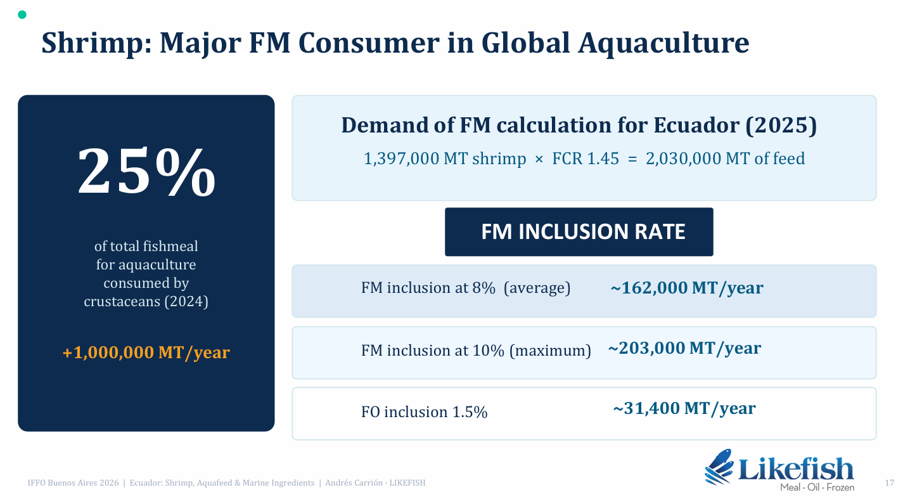
With projections for 2030 reaching 2 million MT of shrimp production and 2.7 million MT of aquafeed, demand for marine ingredients is expected to remain robust. Feed accounts for 50% of production costs and the average feed conversion ratio (FCR) for shrimp shows that 1.45 kg of feed produces 1 kg of shrimp in Ecuador, and in 2015 2.1 million MT of feed is consumed by shrimp in in Ecuador. Improvement in FCR reduces feed volume, but production growth is more than compensates. He concluded that “Actual market conditions are playing against marine ingredients inclusion rates, with high prices and low availability driving reduction in inclusion rates, we need to sell the benefits of marine ingredients. However, marine ingredient demand is set to be robust over the next few years in Ecuador, and it represents an important commercial opportunity for marine ingredient suppliers, with a reliable supply playing a key role in supporting the sector’s continued growth”.
Building resilience in salmon farming
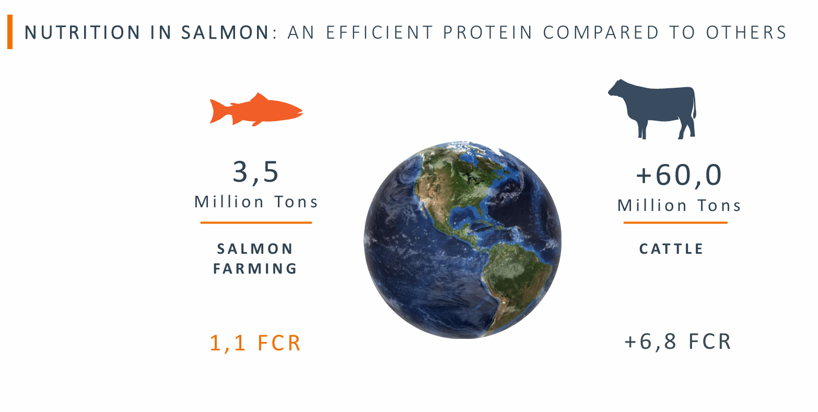
 Providing an update from the salmon farmer perspective, Sady Delgado, AquaChile, stated that aquaculture is essential in the south of Chile, with regional suppliers of the value chain, promoting jobs in small & local communities, with thousands of startups leading to an innovation ecosystem. Aqua Chile exports to over 60 countries and, producing over 100 million tonnes per month. Delgado highlight how efficient salmon is as a protein compared with beef, with a 1,1 FCR compared with 6,8 FCR in beef. Marine ingredients inclusion has dropped in recent years, Delgado noted “that this is not driven by price but by knowledge, we have plenty of options now for salmon diets. But I want to thank the marine ingredients industry for supporting our industry from the beginning.”
China Market Update
 IFFO’s China Director Maggie Xu then presented her market update, starting with a regulatory update. She stated that China’s Ministry of Agriculture has revised the feed ingredients catalogue and starting from this June, allowing more aqua-based products to be used in feed production. Xu added that the list of mandatory parameters to be included in the Chinese label of fishmeal has also changed.
Moving to market trends, Xu noted that raw catches continue to remain at stable levels with strong catch limits remaining; tilapia processing volumes also remain stable, but there was an overall decline in fishmeal and fish oil outputs, with 69% coming from whole fish in 2025. Domestic output estimates of 2025 have been updated following releasing of official fishery statistics by Ministry of Agriculture while those of 2026 are expected to grow year by year to fill the gap from short supply in international markets. Xu added that there has been an increase in both fishmeal and fish oil imports in 2025, with Peru dominating, but this has reduced in 2026 with increasing supply of fishmeal imports from India and Vietnam, due to reduced fishing in Peru.
Xu stated that “competition in the aquafeed markets is expected to be white-hot, with rising feed process and feeding cost, causing thin profit margins, this will drive changes in farm management, a more diversified landscape with increased focus on high value-added species. In shrimp, Xu added that there also an increased focus on precision farming and investment in technology”. Aquaculture consumption of fishmeal still dominates, representing 97.2% of the countries consumption, but this is expected to decrease in 2026. Fish oil consumption by aquaculture in China also grew to 61.4%, followed by fish oil for direct human consumption 30.5% and pet food (8.2%). She added that fishmeal demand by pig feed sector is expected to move down year on year too, given the persistently weak demand towards piglet caused by sustained low pig prices.
Building stronger social license
Presenting the varying socio economic factories that impact fisheries and marine ingredients industry, Veronique Jamin, Communications Director at IFFO, stated that “feed ingredients used to be a blind spot and now they are becoming increasingly analysed”. Marine ingredients sit at the very start of global food systems and are increasingly expected to demonstrate their social licence to operate. Today, scrutiny extends beyond environmental impacts to include broader socio-economic considerations across value chains. Healthy fish stocks remain the foundation of future production, economic value and global food security.
Like any natural resource-based sector, fisheries cannot sustain long-term prosperity through overexploitation and instead require strong governance and effective management. With public finances under growing pressure, governments may need to rely more on industry participation in fisheries governance, as demonstrated by Fishery Improvement Projects (FIPs).
“Building social licence begins with understanding who participates in the value chain and how regulation, science, markets, finance, certification and technical support shape outcomes.
It also requires identifying innovations that can help address environmental, economic and social challenges” Jamin explained. To support this approach, IFFO and SFP created the Global Roundtable five years ago, which now brings together 13 members and has launched a study on socio-economic dynamics in India's marine ingredients sector. The study aims to map stakeholders, distinguish evidence from perceptions and better understand who bears the costs and benefits of change. West Africa remains a focal point of public scrutiny, yet recent developments in Mauritania suggest that improved fisheries management can support increased exports of fresh and frozen products to African countries. Gaps and challenges remain significant and Africa's food security challenges highlight the importance of transport, logistics, energy infrastructure and broader economic development beyond fisheries alone.
“As marine ingredients remain essential to food systems and will continue to face public scrutiny, science, socio-economic analysis and innovation must guide efforts to build responsible and resilient value chains”, she concluded.
Real world example of value added ingredients:
 Highlighting the opportunities for value added ingredients, Arnt-Ove Blytt-Tøsdal Kolås from Pelagia stated that this has been a huge challenge for their company. These challenges range from the variation in biological size, fat and quality, changing with season and catch; he added that markets are often immature, so companies need to learn fast on what the ingredient does; and a good result in a lab is not always a good result in a factory. As an example of the challenges faced, Kolås, highlighted the problem of pinbone removal, with machines being unable to remove them efficiently, with development of a new method has taken over 9 years and the answer has been to work directly with robot companies.
Kolås stated that “we saw value in fatty acids that others overlooked. Long-chain monounsaturated fatty acids (LC-MUFAs) are about 25% of mackerel oil, we knew that LC-MUFAs existed, but our task was to find their value and a method to get it.” Their product was developed in stages, with each stage reduced risk, with preclinical trials and then the clinical trial showing a 7% lower LDL cholesterol level.
But good science does not make a good product, Kolås added that “we needed to ask a series of questions before moving on with development, asking if it nutrient biologically relevant, can we concentrate it consistently at scale, can we control quality from batch to batch, and finally is there a market and a buyer?” The result of this project is the world's first concentrated Omega-9 and Omega-11 oil, and a platform for new marine lipid products. He concluded that “Victory waits for a team that does everything in order.”
You Can Only Manage What You Measure
 IFFO’s Brett Glencross next gave an update on how life cycle assessment (LCA) can provide transparent, comparable measures of the environmental impacts linked to marine ingredient production. Glencross noted that the feed industry is increasingly focused on sustainability, and to answer this Life cycle assessment (LCA) assesses impacts all the way along a production system chain, from raw material extraction (capture), processing, distribution, consumption/use, and waste disposal. But first he stated: “you first need to define the boundaries of the system, then decide how to collect the data and what system to feed into”. Glencross added that “the data collection challenge is huge with GFLI and PEFCR mandate ruling that we use a 1% “cutoff”, meaning everything contributing more than 1% of the footprint needs to be included in the assessment”.
The analysis shows how environmental footprints vary across the industry, particularly as data collection expanded from 53 datasets covering 26 products in 2025 to 370 datasets covering 52 products in 2026. This broader evidence base is improving visibility of sustainability performance, as well as correcting earlier oversights and errors across fishmeal and fish oil supply chains. Glencross added that there are “rules” set around how we must calculate impacts and following the GFLI data collection process allows an effective comparison of impacts across ingredients. By using primary data, collected from Members, our industry now have clear visibility on our Life Cycle Impacts, and it shows that all ingredients have variability in their impacts, and origin is important.
Glencross concluded that “consistent data collection supports meaningful ingredient comparisons, identifies opportunities for stepwise improvement, and helps the marine ingredients sector meet market expectations for credible LCA evidence”.
Major trends in fish oil production, consumption and trade
 Providing an update on fish oil markets, Christian Meinich from Chr.Holtermann presented the record high prices for fish oil, driven by El Nino, but also by challenges in other regions. In terms of consumption, fish oil price has been highly volatile and algae use is therefore increasing and becoming more of a necessity to secure supply for EPA and DHA. Looking forward, fish oil consumption is expected to remain steady, with a slight downturn after a peak in 2025. Certified oils have reduced in both Peru and Scandinavia again likely recovery next year. With no second fishing season in Peru this year, Meinich expects a full recovery in production levels by the second season of next year.
Meinich stated that “the market is very tight, with Russian sardines disappearing since 2025 and the Scandinavian 2026 quotas sharply reduced. So there has been little additional global fish oil production despite all time high fish oil price, with any increased production coming from China.” An example of this tight supply Meinich says is shown by a leading Norwegian brand of tinned mackerel has less mackerel in the can – “a warned catastrophe”. Meinich stated “feed companies are compensating the reduced supply of fish oil with algae, with 1/3 of EPA and DHA for Norwegian salmon production now coming from algae, the limit is predicted to be around 40% so we are approaching this fast.”
Omega-3 ingredient markets
 Covering Omega-3 ingredient markets, Aldo Bernasconi from GOED, showed that demand for direct human consumption and pet food consumption grew by 2.6% in 2025, which is consistent over the last decade. Growth is faster in China at nearly 8% and emerging markets of India, Africa, the Middle East and LATAM are increasingly seen as providing growth opportunities. Petfoods consumption of Omega-3 is growing fastest, especially in China. Bernasconi added that dietary supplements also grew, whereas pharmaceuticals consumption remained flat. Bernasconi added that krill oil consumption in China has tripled in recent years, and there is also a move from refined oils to concentrates. For EPA and DHA growth, he noted, it has grown slightly faster growth due to a gradual switch to concentrates and algae. Omega-3 capsule consumption is expected to continue to grow as consumer interest is stable and growing alongside the growth in the use of multivitamins. He added that “most crude oils (56%) used for omega-3 products come from anchovies, sardines and similar reduction species, or by-products from the seafood industry.” The shortage of oils won’t impact the market until the middle of next year, due to the longer production times that causes a lag in the market.
He concluded that “the omega-3 industry is extremely reliant on anchoveta, which creates risk when there are inevitable supply disruptions. There is now increased reliance on other (new and existing) sources and production of concentrates is more efficient. A Future El Niño event would still cause disruption so we need to find other sources.” Changes in formulations has helped stabilise supply but regulatory and marketing barriers continue to block this. In terms of alternatives to fish oil, GMO seeds have low omega-3 cost and are not gaining traction, and algae costs are still high and purely DHA.
Closing remarks
 Closing the conference, IFFO’s Director General, Petter Martin Johannessen concluded that “there is one message is clear: in a changing and uncertain world, our industry must stay resilient. That resilience comes from good science, strong collaboration, continued innovation, and the responsible use of marine resources.
Over the past three days, we have heard how important science-based fisheries management remains. We have also seen the value of working together across the whole supply chain. Responsible sourcing, circularity, better use of resources, and value creation are all part of our contribution to future food and nutrition needs. By continuing to share data and remain open to scrutiny, the IFFO membership helps build trust and supports informed discussion. This afternoon’s workshop will take that discussion further by looking at the environmental impacts of our industry and how they compare with other feed ingredients.”