








 A joint IFFO – Lucta InFocus Workshop was held on 17 May 2026 in Darwin, Australia, on the sidelines of the International Symposium on Fish Nutrition and Feeding (ISFNF).
It brought together leading experts from academia and industry to address a critical challenge in aquaculture feed development: the integration of palatability into feed formulation systems. The event was designed as an invitation-only forum to foster focused discussion. To frame the discussion, a series of presentations was prepared by Brett Glencross (IFFO), Sofia Morais and Thiago Raggi (Lucta S.A.), Marit Nederlof (Wageningen University - WUR), Andre Dumas, Hung Quan Tran (ADANS), Albert Tacon (AquaHana LLC) and Richard Smullen’s (Ridley AgriProducts).
Together, these presentations provided the scientific and industry perspectives that set the scene for the group discussion that followed.
Why focus on palatability?
In aquaculture, voluntary feed intake is a primary driver of growth, efficiency and economic performance. Despite its central importance, palatability - the sensory dimension influencing feed acceptance and intake - is typically handled empirically in feed formulation. At the same time, scientific advances in fish taste biology, gut nutrient sensing and appetite regulation have significantly improved our understanding of how intake is regulated. However, this biological knowledge remains largely disconnected from practical feed formulation systems, where parameters must be measurable, comparable and mathematically integrable.
As marine ingredient inclusion declines, alternative protein sources - many of which are plant-based and naturally more challenging from a palatability perspective - increase, along with overall diet complexity. Consequently, systematically addressing palatability within formulation strategies becomes increasingly important.
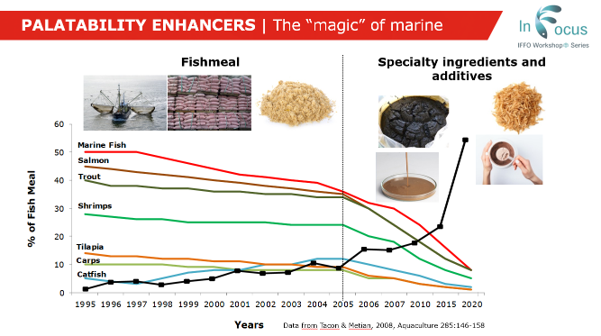
Source: Presentation by Brett Glencross, IFFO
This raises a central question: how can knowledge on taste biology and feed intake regulation in fish be translated into quantifiable inputs usable in formulation matrices?
The central objective of the workshop was therefore to explore whether palatability could be formalised into a measurable and formulation-relevant parameter, i.e a Palatability Index (PI). The workshop did not seek to define a specific index. Rather, it sought to start a structured conversation on whether - and under what conditions - palatability could be represented as a formulation-relevant parameter.
Across the presentations and discussions, several recurring themes emerged:
- The need to distinguish clearly between biological understanding and formulation applicability.
- The importance of developing quantifiable, standardised metrics, that are commercially relevant.
- The challenge of aligning short-term behavioural responses with long-term nutritional outcomes.
- The necessity of collaboration between academia and industry to bridge knowledge gaps.
Defining and understanding palatability
While hedonic feeding drives short-term, sensory-driven responses, homeostatic feeding governs long-term, nutrient or energy-driven regulation.
Sofia Morais (Lucta S.A.) and Marit Nederlof (WUR) noted that the pleasantness of food, and its ability to influence behaviour, drives the motivation to eat. This is linked to the sensory experience of taste but is also affected by nutritional needs and individual preferences. Chemostimulants, in the form of low molecular weight and water-soluble substances released from potential prey items (such as soluble protein, nucleotides, nucleosides, soluble nitrogenous compounds like TMA, and organic acids) stimulate aquatic animal senses and elicit attractability or palatability responses. “Animals have evolved sensory mechanisms to guide them in making appropriate food choices: fish and shrimp require nutrients, not ingredients. But nutrients, or their sources, need to be recognized as food, therefore animals choose ingredients”, they added. High variability in food preferences is key to fish’s evolutionary success. It is important to note that for fish, taste sensing continues after feed ingestion. Gastrointestinal responses to ingested food regulates feeding efficiency through modulation of satiety, gut transit, digestion and absorption.
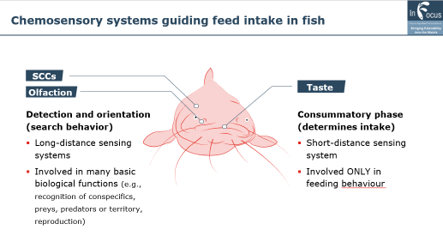
Source: Presentation by Sofia Morais (Lucta S.A.)
As for shrimp, they rely mostly on chemical cues to locate food. They have a vast array of sensory receptors (sensilla) distributed over their body for sensing food. “There are 2 chemosensory systems in shrimp: olfaction, which is restricted to the antennules, where the receptors react only to chemical signals; and distributed chemoreception, which is found in the rest of the body, with a higher concentration in the head, walking legs and tail. Here, these receptors are sensitive to both chemical and mechanical stimuli, including also food texture or hardness”. Feed ingested and eating speed is reduced as the concentration of chemostimulants decreases. Sensory input from the mouthparts and legs is key to keeping the motivation to eat.
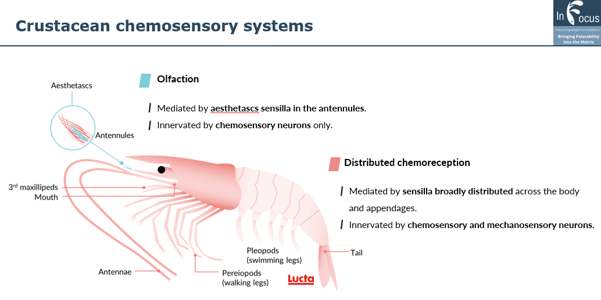
Source: Presentation by Sofia Morais (Lucta S.A.)
When we analyse homeostatic drivers (nutrient balance), fish eat to satisfy their energy and/or nutrient requirements, according to several studies. However, external factors such as stress and environmental conditions also play a clear role.
As such, feed intake in fish is a behaviour resulting from the dynamic interaction between sensory perception, gut nutrient sensing, metabolic regulation, and environmental context. Palatability acts as the interface linking external feed properties to internal physiological needs.
The presentation by Hung Quan Tran and André Dumas (ADANS) focussed on the assessment and modelling of palatability in aquatic species. Demand feeders were presented as valuable tool to study feed preference of fish and suitable for studying feeding rhythms and circadian cycle. However, demand feeders present limited utility for the assessment of feeding behaviour, with false triggering sometimes happening. Moreover, time is required for acclimation to the trigger system, and not all species can be trained. When we consider compartmental feeding preference systems, they are a valuable tool to study feed preference and make it possible to assess certain feeding behaviours. They too require time for acclimation, are labour intensive and not all species can be trained on that system. Looking at passive acoustic monitoring, it is valuable for studying the feeding activity of shrimp and is applicable in farms. It is, however, expensive and its suitability for fish remains limited. As for machine learning, it is applicable to both fish and shrimp and proves to be an effective approach to uncover relationships that conventional analytical approaches might overlook. Programming skills are needed for machine learning to be used, and water must be shallow, clear and clean. Andre Dumas concluded by noting that methodology to study palatability varies depending on species and study objectives. “Modelling palatability should be the next step, while additivity of stimulants remains to be described”.
Next, Albert Tacon (AquaHana LLC) delivered a presentation on natural feeding habits and essential dietary nutrients. The starting point in the formulation of a diet is first to have an understanding of the natural diet and feeding habits of the species in the wild over its life cycle; the latter being adapted over millions of years to a particular diet and nutrient profile; in the case of fish over 500 million years. As a general rule, herbivorous species have a digestive system geared to the intake of large amounts of nutrient poor feed items on a regular or continual basis, whereas carnivorous species have a digestive system geared to the intake of nutrient rich animal-based feed items on an irregular basis. A nutritional analysis of common natural food items consumed by the target species in the wild can be an instrumental step in the process. Plant feed ingredients present endogenous anti-nutritional factors (ANFs). Human population expansion coincided with the development of cooking which, by destroying ANFs, brought about a major evolutionary advantage to humans in the form of cooked vegetable foods.
Today, shrimp feed formulation is made up of 50+ essential nutrients in biologically available form. To meet the needs for these nutrients, there is virtually no ingredient alone that can meet the demands. This is why finding complementary ingredients is so critical, but it can introduce palatability challenges.
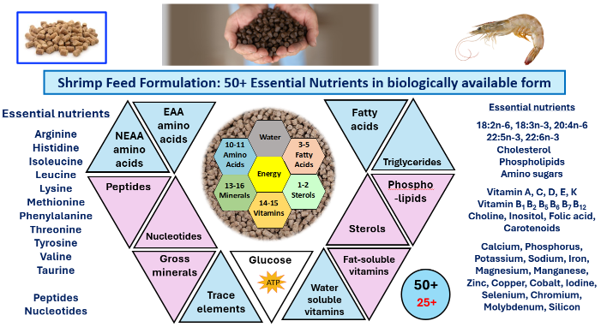
Source: Albert Tacon’s presentation
The art vs science of formulation
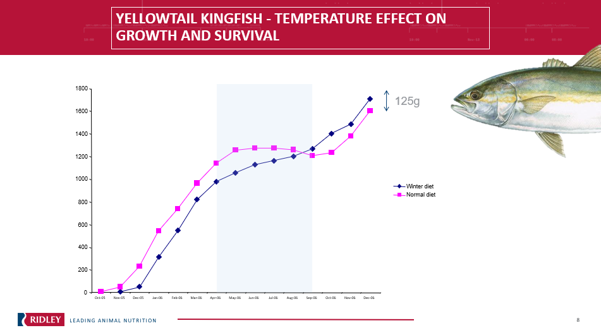
Richard Smullen´s (Ridley AgriProducts) presentation was delivered by Brett Glencross, who introduced Australian aquaculture as a climate-constrained industry: at thermal limits, feed intake stops first, then growth, leading to subsequent deterioration of the immune function. As a consequence, parasites, jellyfish, algal blooms and pathogens exploit the gap.
Source: Richard Smullen’s presentation
But “even the best digestibility metric only tells half the story” he noted. “Fish won't eat what they don’t want – irrespective of digestibility”. Raw material quality directly impacts palatability and intake. Ingredient variability, processing conditions, freshness and anti-nutrient content all affect the palatability signal the animal receives. This is under-recognised in standard formulation practice.
Not all palatants are created equal: hydrolysates appear to illicit different responses from fish, and their effects can be cumulative; therefore, co-inclusion can be complementary. Despite their benefits, there are problems and not all of them are biological. Hydrolysates work best when added externally, but they make the outside of the pellets “sticky”, causing potential logistical issues with managing feed delivery systems.
Glencross concluded that there is no easy specification for palatability. “Unlike lysine or EPA+DHA, you cannot specify palatability in a formulation matrix. The only reliable measure is voluntary feed intake, which means the effect only becomes visible after the trial has run”. The biology is compelling and the commercial reality is complex. A product that works in a trial may be impossible to run at scale. Understanding both sides is what separates art from science in feed formulation.
Setting the framework for a Formulation Palatability Index: group discussion
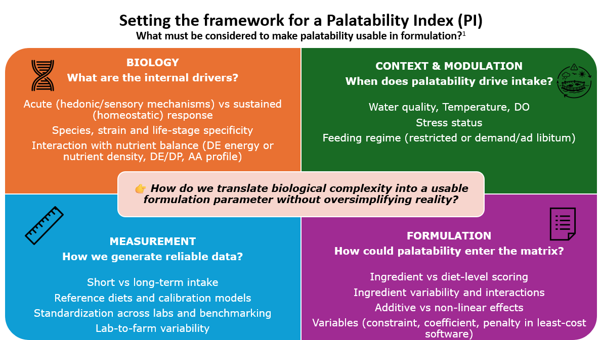
Participants reflected collectively on the palatability challenges during a session aimed at gathering thoughts from the audience. Framing the debate, Thiago Raggi (Lucta S.A.) underlined that palatability is biologically real, commercially critical, but mathematically absent from formulation systems. Brett Glencross then chaired the discussion, asking how knowledge on taste biology in fish could be translated into quantifiable inputs relevant for formulation systems. “In this workshop, we are not trying to define a palatability index today - only to explore what it would require. The objective is to define whether and how a palatability index could be constructed in a formulation-relevant way. We are trying to integrate something biologically complex into something mathematically constrained. The underlying question is as follows: is palatability a constant coefficient, or a context-dependent/modulated variable? Is palatability always equally important? When does it matter the most?”
Source: Presentation by Thiago Raggi (Lucta S.A.)
Participants broadly agreed that initial efforts to quantify palatability should focus on hedonic responses, as these are more directly linked to feed attractiveness and immediate intake decisions. It was stated that the first 10 days of feeding trials are most representative of hedonic behaviour.
This distinction was seen as essential for designing experiments and for defining what a palatability index should measure.
Ingredient-based versus diet-based approaches
There was stronger support for developing ingredient-based palatability indices. This approach would allow more flexible formulation and enable nutritionists to predict the palatability contribution of individual raw materials. However, a participant also highlighted the importance of evaluating ingredients within balanced, commercially relevant diet formulations if the results are intended for commercial application. Although commercial formulations are inherently variable, testing should be based on a representative "commercial average" diet.
Participants also noted that current practice often relies on incorporating known palatability enhancers without a clear quantitative framework. Moving towards ingredient-level evaluation was seen as a necessary step in developing predictive models.
A delegate further noted that technological characteristics of the feed, such as pellet hardness, should also be considered, as they may influence feed intake independently of ingredient palatability—for example, by affecting gut evacuation rate—and therefore confound the interpretation of palatability responses.
Experimental design and standardisation
A recurring concern was the lack of standardised methodologies for assessing palatability. Participants broadly agreed on the need for benchmarking diets against well-defined reference ingredients to improve comparability across studies. While fishmeal was initially viewed as the most natural benchmark, it was suggested that soy protein concentrate could be a more suitable alternative, given its more consistent composition and widespread global availability.
There was also broad agreement on the importance of maintaining equal net energy levels across treatments in trials extending beyond the acute feeding response period. Without such controls, differences in feed intake could be misinterpreted as palatability effects when they are in fact driven by energy intake or nutritional imbalances.
Brett Glencross suggested that we could take inspiration from the way digestibility and nutrient requirement studies have been refined over the years and apply these lessons to the development of a standardised methodology for palatability assessment.
Participants highlighted the need for:
- Short-term, standardised feeding trials
- Consistent environmental conditions (temperature, oxygen, salinity)
- Reproducible protocols across laboratories
Environmental variability was identified as a major confounding factor, influencing feeding behaviour independently of feed composition.
Biological and environmental complexity
The discussion underscored the complexity of feeding behaviour in aquatic species. Factors influencing palatability include:
- Species differences and genetic variation
- Domestication history
- Life stage (e.g. larvae versus grow-out)
- Nutritional status and stress conditions
A delegate suggested that initial categorisation could be simplified by grouping species into broad categories such as herbivores, omnivores, carnivores and crustaceans. Several participants supported this idea as a pragmatic starting point, allowing early-stage development before refining species-specific models.
Sofia Morais noted that even closely related species may respond differently to the same feed, while the influence of compensatory growth following a period of growth stagnation due to stress on feeding behaviour was also highlighted by a delegate. Domestication influences feed acceptance, and palatability effects are difficult to demonstrate experimentally.
A range of factors such as time-dependent effects, interactions between environmental conditions and feed composition, complicate efforts to develop universal metrics and reinforce the need for carefully controlled experimental frameworks.
Analytical and modelling approaches
Albert Tacon (AquaHana LLC) and a delegate suggested expanding the chemical characterisation of feed ingredients, including their leaching behaviour and the concentration of putative chemosensory-active compounds. Participants agreed that advancing palatability research will require integration of analytical chemistry and modelling techniques. Developing databases of ingredient characteristics, including peptide profiles, molecular weight distributions and leaching behaviour, before conducting large-scale animal trials was considered a promising strategy.
It was stated that palatability responses are often non-linear. Building on this idea, Andre Dumas introduced the possibility of incorporating palatability into formulation software through mathematical modelling of non-linear dose–response relationships, and suggested that palatability coefficients may need to be calculated at the diet (formula) level, rather than having a fixed ingredient score. This approach would enable palatability to be integrated in formulation models in a way analogous to nutrient constraints, making it directly usable in formulation optimisation.
Practical relevance and industry application
From an industry perspective, the importance of maintaining practical relevance was emphasised to ensure that any proposed system can be implemented within existing formulation workflows.
There was general agreement that while scientific rigour is essential, solutions must ultimately be applicable at scale and compatible with industry constraints.
Conclusions
The workshop concluded with broad consensus on several key points:
- A formulation-oriented palatability index is feasible.
- Initial efforts should focus on ingredient-based systems and short-term hedonic responses.
- Standardization across labs and experimental conditions is essential.
- Both analytical chemistry and biological validation will be required.
- Collaboration between industry and academia is critical for progress.
Importantly, participants recognised that the workshop represented an initial step rather than a definitive framework. The primary achievement was the establishment of a shared understanding of the problem and a clearer direction for future research and collaboration.
While significant work remains, the discussions laid the groundwork for future developments, including the potential creation of a Formulation Palatability Index (FPI). The emphasis on standardisation, modelling and collaboration provides a clear pathway forward, with the ultimate goal of improving feed performance, sustainability and efficiency in the aquaculture sector.
A scientific paper will be produced from this workshop and submitted to a peer-reviewed journal.
Watch clips with speaker insights below: