








This article, authored by Dr Brett Glencross, was first published in the October 2025 edition of International Aquafeed.
It seems that every week there is more news of impending global environmental disaster with an ever-growing list of challenges such as climate change, biodiversity loss, and growing food insecurity.
- Food production has been implicated as contributing more than a quarter of global greenhouse emissions and consequently the sustainability of the entire food system has come under intense scrutiny.
- Of those emissions produced from food production almost a third is attributed to meat and fish production.
A notable focus of that scrutiny has been on aquaculture for some time. And it has been implied that for aquaculture feed to become more sustainable it needs to move towards increased reliance on agriculture. But the evidence does not support this.
Let’s explore the realities
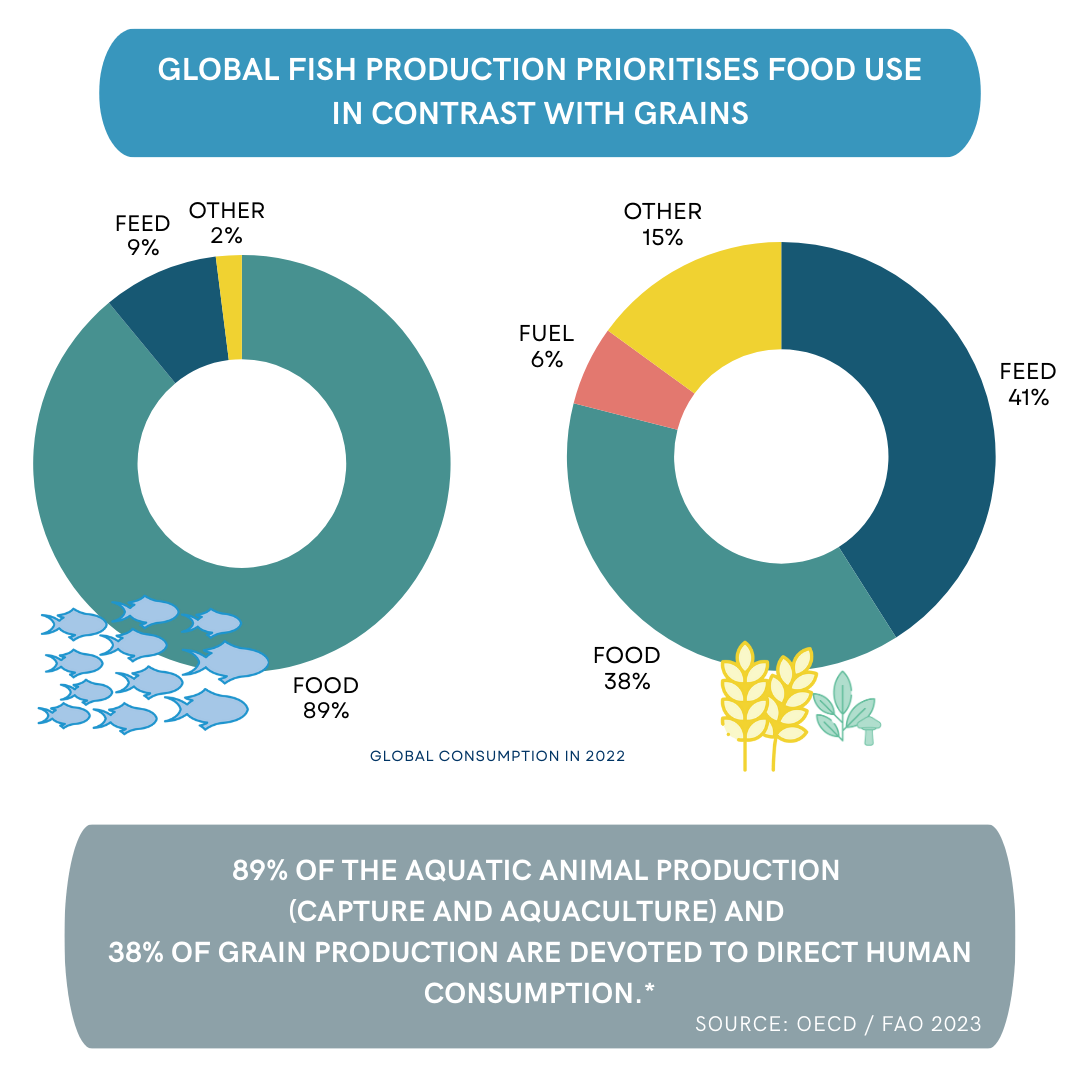
It has long been said that the growth of global aquaculture would lead to increased overfishing and the systemic collapse of fish populations. This was attributed to the perceived fishmeal dependency and the associated environmental, social and economic challenges related to the over-reliance on wild stocks and overfishing leading to the eventual depletion of the marine species. However, the data from FAO going back over 70-years shows that this clearly is NOT true.
- Global fisheries production peaked in the 1990’s at around 90-million tonnes per annum and has held at that yield ever since (now over thirty years!).
- During this time aquaculture has boomed in production to overtake fisheries (91 million tonnes in 2022) to become the majority supplier of seafood (94.4 million tonnes in 2022), whilst also underpinning a growth in consumption from 7kg per person to 21 kg per person each year. It has clearly been one of the world’s major success stories in food production.
- Notably, during the last thirty years the use of fishery resources for non-food purposes (e.g. fishmeal) has declined from ~30 million tonnes to now less than 20 million tonnes per annum (which represents less than 10% of the combined production of aquaculture and fisheries).
- And despite that decline in resource use, fishmeal production has maintained its volume at 5 million tonnes per annum since. How? Through increased reliance on by-products from both fisheries AND aquaculture.
So, if fishmeal use has not expanded over the last thirty years, then how have we fed that boom in aquaculture production?
The fish clearly had to be fed something
We can see that feed use has grown, with use by aquaculture increasing from around 16 million tonnes in the year 2000, to over 50 million tonnes in 2022.
- And the answer is mostly from the agricultural production of feed grains like maize, wheat, soybean, and rapeseed among others.
- Annual global production of grain is just under 3.8 billion tonnes each year. More than twenty times the production from fisheries and aquaculture combined. Of those 3.8 billion tonnes, over 40% is fed to an animal, including fish.
- A massive 1.5 billion tonnes of grain is fed to animals each year. Just over 1.4 billion tonnes of grain is used as food. Yes, more of our global grain production is used as feed than food. With fish use as a feed resource that proportion is less than 10%.
- So, since the year 2000 when marine ingredients made up about 25% of global aquafeed production, modern aquafeed production now uses less than 10% and is much more dependent on agricultural production for feed resources, not because it improves sustainability, but rather because it increases supply.
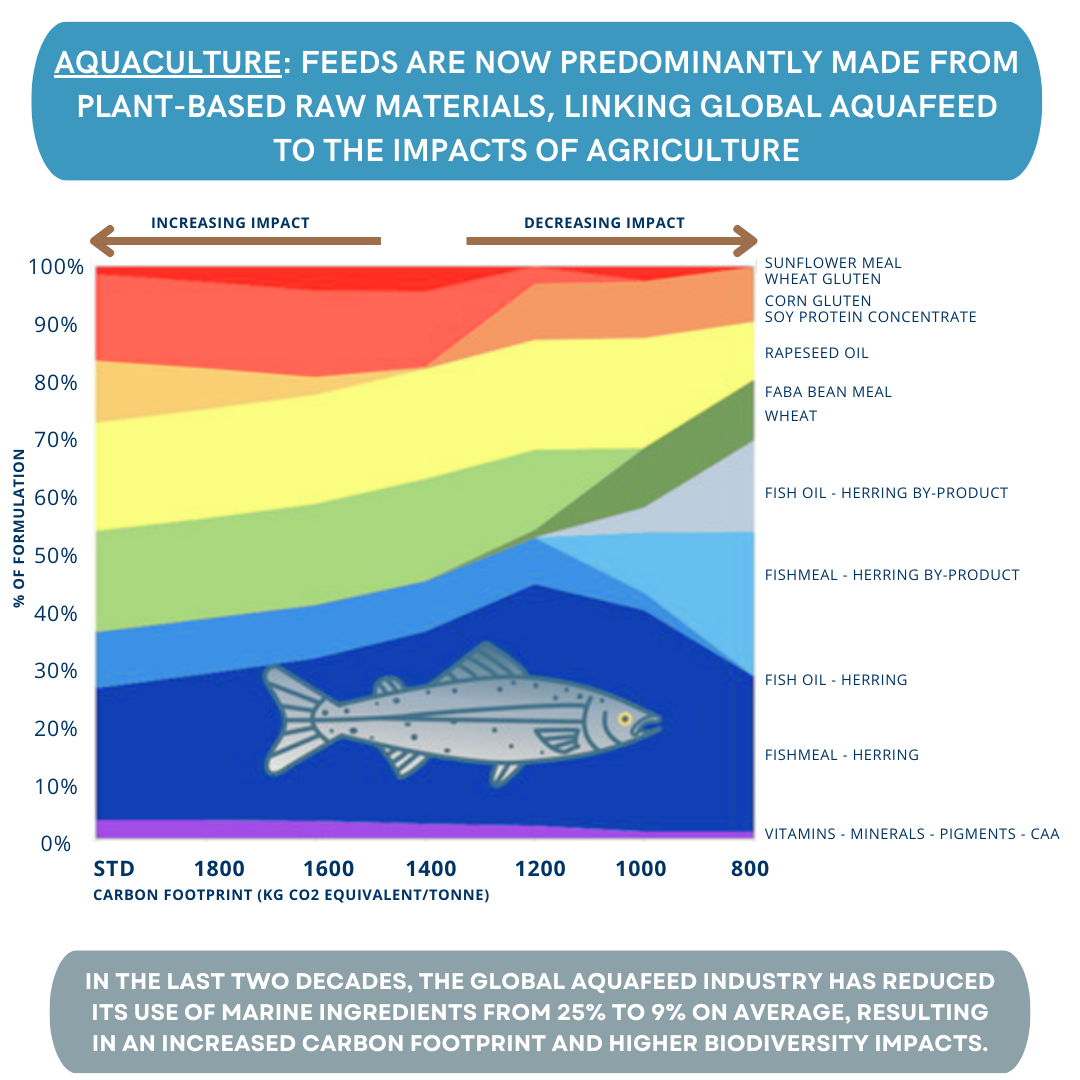
This shift in resource use over the last few decades has not been without consequences though
A quick review of the Global Feed Life cycle assessment Institute’s database shows that most agricultural sourced protein and oil products have significantly higher impact burdens than marine ingredients.
- For example, rapeseed oil typically has a carbon footprint of over 2000 kg CO2-eq per tonne compared with the global average fishoil with a carbon footprint of 1400 kg CO2-eq per tonne.
- Many of the fish oils used in salmon farming have footprints even lower still, like anchoveta oil at 730 kg CO2-eq per tonne and Herring by-product oil at 540 kg CO2-eq per tonne.
So, while we improved our security of supply with the use of agricultural products, issues with things like climate change impact, land use dependency, biodiversity impacts and so on have all increased as we have increasingly relied on agriculture. The environmental damage caused by agriculture over the last 10,000 years dwarfs that of what we have done to the oceans through fishing and aquaculture. Arguably even much of the damage we have done to our coastal areas has been from “upstream” activities rather that we were doing on the coast and seas. Land clearing, biodiversity loss, freshwater reserve depletion, pesticide use and so on are legacies of agriculture that are unmistakable and often long-lasting.
Despite its legacy of impacts, agricultural systems are likely to remain an indispensable part of the solution
They are the only scalable option (and we’re talking in the millions of tonnes here) we have for providing the feed resources we need. As promising as algae and single-cell ingredients are, they are not going to deliver anything over a million tonnes by 2050. While agriculture is not a sustainable system of food and feed production, it is the best and most reliable one we have. So, we better work with it and fix it.
The best way to mitigate carbon-footprint is to improve efficiencies and yields. We need to reduce pesticide use through better plant breeds. Restore soil fertility and health through better landscape and cropping management. We need to regenerate biodiversity through reversing deforestation. We can also help by moving food production from the land to the sea, where both land space and freshwater use is not constrained. Not just fish production, but through a more diversified aquaculture approach with algae, filter feeding invertebrates, and yes also more fish.