








London, 15th January 2026
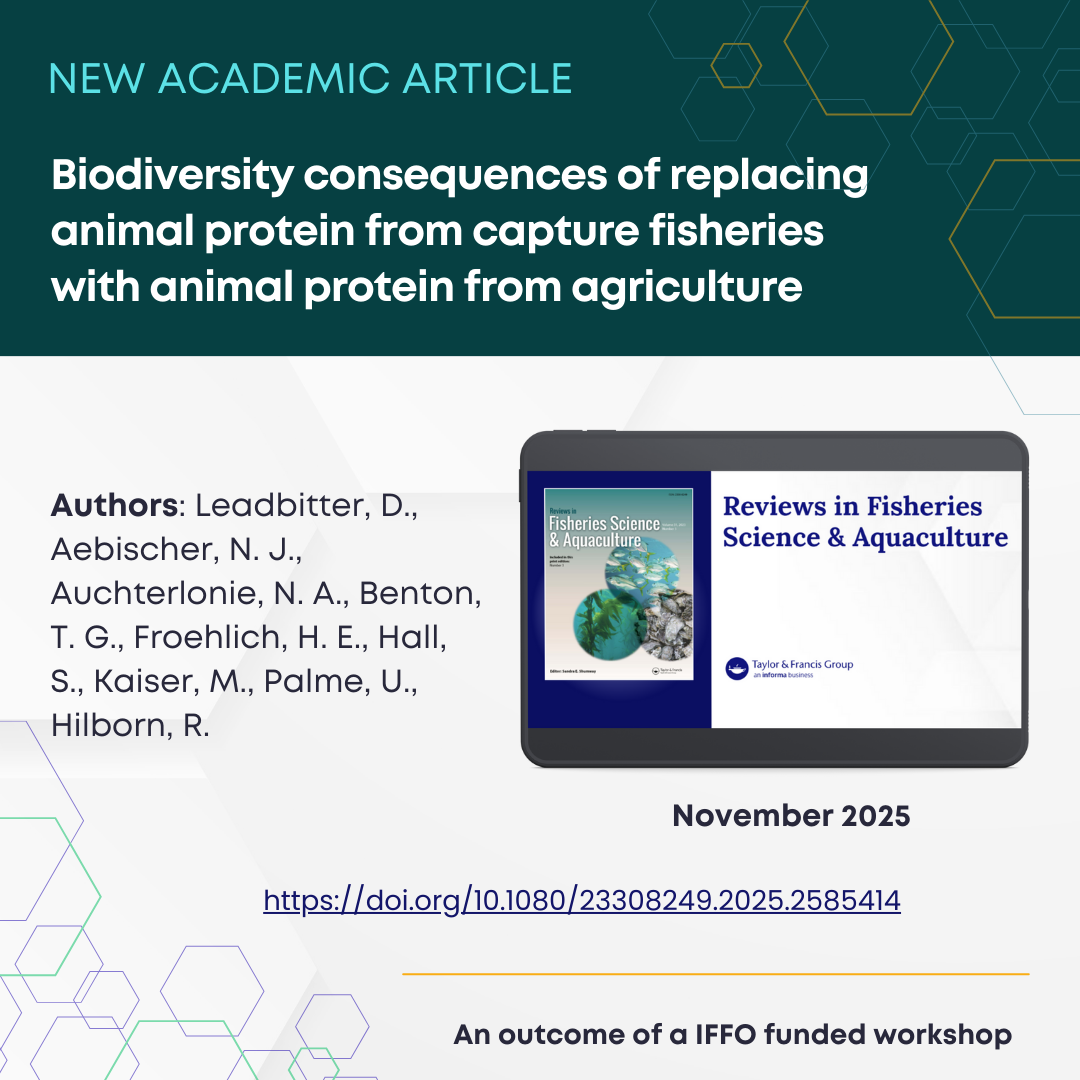
IFFO, The Marine Ingredients Organisation, announces the publication of a new open-access paper led by Duncan Leadbitter (Australian National Centre for Ocean Resources and Security, University of Wollongong) in Reviews in Fisheries Science & Aquaculture. The paper, available here, is the independent outcome of a workshop funded by IFFO, bringing together leading scientists* to explore the impacts of global food production.
“This peer-reviewed article underscores the essential role of responsibly managed fisheries in sustainable food systems and biodiversity protection. Despite their impacts, agricultural systems remain vital for feeding a growing population. However, more tools are needed to enable objective, localized comparisons between the biodiversity impacts of land-based animal protein production and marine fishing. With this in mind, IFFO has started a pilot project to transition current discussions to a biodiversity framework outlining indicators to measure impacts and guide decision-making,” said Dr Brett Glencross, IFFO’s Technical Director.
The paper’s key findings:
- The expanding global population is driving an increasing demand for food production, further accelerating land use change, which is widely accepted as being the major factor driving global biodiversity loss.
- Approximately 83% of the expansion of global agriculture in the 1980s and 1990s replaced tropical forests.
- Replacing animal protein sourced from marine capture fisheries with animal protein from agriculture will likely increase the threats to biodiversity: whilst there is a wide range of farming methods, and not all crops have equal impacts, there is limited potential to produce food on land without removing native vegetation.
- Integrated food systems are critical: holistic assessments of feed ingredients and food production systems are needed to avoid trade-offs that simply move environmental impacts from oceans to land.
Duncan Leadbitter, lead author of the paper, stated:
“There are choices to be made as to how more food will be produced in the coming decades and what unintended land use and biodiversity consequences will be produced from these decisions. Replacing all animal protein from marine fisheries could require almost an additional 5 million km2 of land – larger than the extent of intact rain forest in Brazil. Replacing all fish products in aquaculture diets would result in the need for over 47 000 km2 of new land converted to agricultural production. Well-managed fisheries do not rely on fundamental changes to ecosystems in the way that agriculture does and there is lots of progress in improving fisheries management underway.”
The full article is free to view at Taylor & Francis Online, https://doi.org/10.1080/23308249.2025.2585414
Infographics are available here.
* Leadbitter, D., Aebischer, N. J., Auchterlonie, N. A., Benton, T. G., Froehlich, H. E., Hall, S., Kaiser, M., Palme, U., Hilborn, R.